Delaware Statutory Trust as 1031 Replacement Property
DSTs let 1031 exchangers buy into institutional real estate with fixed, IRS-blessed terms.

A Delaware Statutory Trust is one of the few structures the IRS has explicitly blessed as replacement property in a 1031 exchange, and that ruling has opened a path for exchangers with large, complicated, or awkwardly timed transactions to get deals done. Most investors evaluate a DST the same way they'd evaluate a rental property: cash flow, location, cap rate. That's the wrong framework entirely. A DST is a legal structure with a fixed set of restrictions baked in at closing, and understanding those restrictions matters more than understanding the real estate, especially once the 45-day identification clock starts running.
The IRS ruling that made DSTs qualify as 1031 replacement property
Revenue Ruling 2004-86 is the document that made all of this possible. It established that a beneficial interest in a properly structured Delaware Statutory Trust counts as a direct interest in real property for purposes of Section 1031, not a security interest in a business entity, which would have disqualified it entirely.
Before that ruling, investors who wanted fractional ownership of institutional-grade property used tenant-in-common structures. TIC deals worked, but they came with real friction: co-owners had to coordinate on major decisions, and the structure was subject to a practical investor cap. The 2004 ruling gave sponsors a way to raise capital from many investors under a single trust, with a single trustee, and still have each investor's interest treated as real property rather than a security in a business.
That said, the ruling doesn't touch the underlying mechanics of a 1031 exchange. The 45-day identification window still applies. The 180-day closing deadline still applies. The exchanger still can't touch the sale proceeds without triggering constructive receipt, and the replacement property still has to be held for investment or for productive use in a trade or business. A DST interest identified by name within the 45-day window satisfies the identification rule the same way a piece of physical real estate would. Nothing since 2004 has narrowed the ruling or taken it off the table. As of 2025, it remains the operative authority.
The Seven Deadly Sins restrictions that DST sponsors must follow to preserve 1031 eligibility
The ruling came with strings attached, and sponsors call them, informally, the Seven Deadly Sins. Once the trust closes and capital is raised, the trustee cannot accept additional contributions from investors, existing or new. The financing is frozen too: no renegotiating the loan, no new borrowing, whatever debt terms existed at acquisition are the debt terms for the life of the trust.
If the property sells, the proceeds get distributed to investors rather than reinvested into another asset. The trustee can't sign new leases or renegotiate existing ones except in narrow, specified circumstances, and capital spending is limited to ordinary repairs and maintenance rather than upgrades that would change the character of the asset. Cash sitting between distribution dates can only go into short-term debt obligations, nothing else. And the trustee's authority to enter into new contracts or materially alter existing ones is sharply constrained.
None of this is sponsor preference, and treating it that way is the first mistake new DST investors make. These are structural conditions the IRS attached to 1031 eligibility. Violate any one of them and the tax treatment for investors in the trust can unwind. So sponsors do all the negotiating up front, before the offering ever closes: financing gets locked in, leases get signed, the operating profile of the asset gets fixed. What an investor buys into is a fully built, non-adjustable position. There's no steering the ship once it's left the dock, and anyone who buys in expecting a voice in operations has misread what they're holding.
How an investor actually uses a DST to complete a 1031 exchange, the mechanics step by step
The relinquished property sells first, and the proceeds go straight to a Qualified Intermediary, never to the investor. Touching that money, even briefly, kills the exchange.
From there, the clock starts. Within 45 days of the closing on the relinquished property, the investor has to identify the DST offering by name, in writing, through the QI, specifically enough that there's no ambiguity about which interest is being claimed. Somewhere in that window, usually before or right after the sale closes given how little time there is, the investor reviews the DST's private placement memorandum: property description, sponsor track record, debt terms, projected distributions, exit strategy. Once the offering is selected, the QI wires the funds directly to the DST sponsor or an escrow account, and the investor receives a beneficial interest certificate representing a fractional stake in the trust. The exchange gets reported on IRS Form 8824 for the tax year the relinquished property sold.
The 45-day window is the tightest part of the entire process, tighter than most first-time exchangers expect, and waiting until after the sale to start looking at DST offerings is how deals fall apart. Investors who haven't already screened offerings before they even list their relinquished property routinely find themselves scrambling. That's part of why DSTs get used as backup identifications alongside a direct property purchase: if the primary deal falls apart, the DST absorbs the remaining proceeds and keeps the exchange alive. Partial allocation works too. An investor can split proceeds between a DST and a directly titled property, as long as both are identified inside the 45 days and closed inside the 180. Minimum investments set by sponsors can be substantial, and the accredited investor requirement applies across the board, no exceptions for exchange size.
What DST properties actually look like, asset types, scale, and how offerings are structured
DST offerings are generally built around institutional-grade commercial or multifamily real estate, the kind of asset that would take significant capital to acquire directly: apartment communities, retail centers, industrial buildings, healthcare facilities, office properties.
The scale of activity on platforms sponsoring these deals gives a sense of how far this has moved from a boutique product. JLL Exchange, for instance, brought several programs to market in close succession: JLLX Diversified V closed fully subscribed at $100 million in November 2024, Diversified VI followed at $104 million in February 2025, Diversified VII came in at $105 million (structured across two separate trusts) by late April 2025, Diversified VIII reached $158 million by late May 2025, holding a 323-unit multifamily community in one city and a roughly 147,000-square-foot grocery-anchored shopping center in another, and Diversified 9 closed at $168 million in July 2025. Across 26 offerings since the platform launched in 2019, JLL Exchange has raised more than $1.85 billion.
That kind of volume doesn't happen on the fringes of the market. LaSalle Investment Management, the sponsor behind JLL Income Property Trust, managed $82.3 billion in assets globally as of the fourth quarter of 2024, which puts the institutional weight behind these programs on a different scale entirely than a small syndicated 1031 deal put together by a local sponsor. Diversified DSTs, meaning trusts holding more than one property, give investors a way to spread risk across assets and markets rather than concentrating everything in a single building, which matters a great deal to someone stepping out of one directly owned property for the first time. Five consecutive programs fully subscribed in under a year isn't a niche corner of the exchange world anymore. It's become a real channel, and the volume alone should tell skeptical investors this isn't a fringe workaround.
The UPREIT pathway, how DST investors can convert their interest into REIT shares on a tax-deferred basis
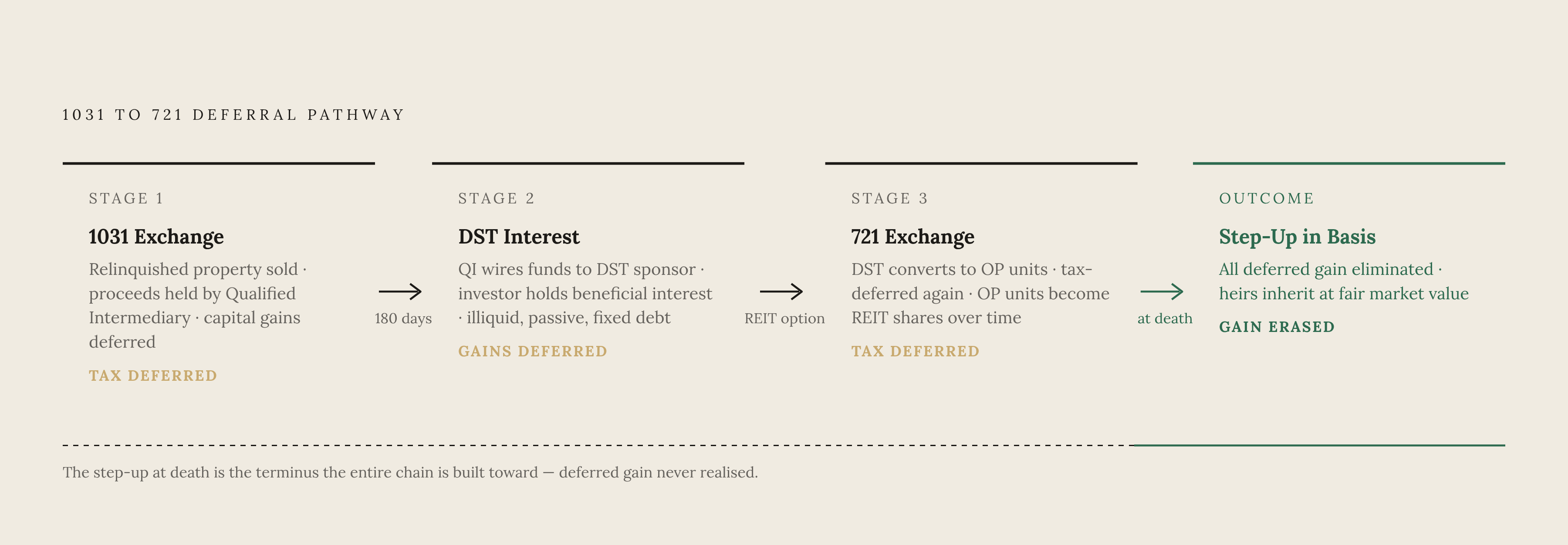
Some DST programs are built with a further step in mind. After a required holding period, the REIT sponsor behind the trust may exercise an option to acquire the DST's underlying properties, and in exchange, DST investors receive operating partnership units in the REIT rather than cash. That's a Section 721 exchange, and it's tax-deferred in its own right.
Stack the two together and an investor who holds through the full cycle gets two sequential deferral events: the 1031 exchange defers tax on the sale of the original property, and the 721 exchange defers tax again when the DST interest converts into OP units. Those OP units, in turn, can typically be converted into REIT shares over time, which introduces a form of liquidity the DST itself never offered.
JLL Income Property Trust has completed 15 of these full-cycle UPREIT transactions to date, totaling $1.2 billion, with an additional transaction, the Diversified II DST, closing on May 7, 2025 at $185 million in assets. Still, none of this is guaranteed. The REIT has to choose to exercise the acquisition option, and market conditions or strategic considerations could just as easily lead to an outright sale, a refinancing, or simply an extended hold instead. Investors chasing the 721 pathway for liquidity alone are betting on a decision they don't control.
The estate planning angle is where this gets genuinely compelling for older investors sitting on large embedded gains. OP units held at death receive a step-up in basis, which eliminates the deferred gain entirely rather than just postponing it. That's the real reason to want the UPREIT step, not the promise of eventual liquidity in that kind of publicly traded ownership interest. JLL Exchange markets its overall platform, the sequence running from 1031 exchange to DST to 721 UPREIT, as an end-to-end solution. The DST is the entry point. The UPREIT, for investors thinking generationally, is the intended destination.
The trade-offs investors accept when using a DST, illiquidity, loss of control, and structural constraints
None of this comes free, and the costs are structural rather than incidental.
There's no secondary market for a DST interest. Capital committed to the trust stays committed until the sponsor triggers an exit event, whenever that happens to be. There's no redeeming on demand, no selling a slice back to the sponsor because plans changed. And because the Seven Deadly Sins restrictions hand every operating decision to the trustee, an investor who wants a say in property management, leasing strategy, or capital improvements is simply in the wrong vehicle. That's not a limitation of a particular sponsor. It's baked into the legal structure.
Debt is frozen at closing, for better or worse. If interest rates fall after acquisition, investors have no path to refinance and capture the savings. If the market sours, the sponsor can't restructure the loan without threatening the trust's 1031 eligibility for every investor in it. Offering risk compounds the timing pressure already built into the 45-day window: JLL Exchange's own pace of fully subscribing multiple consecutive programs shows how fast a desirable offering can close, and an investor who hasn't pre-identified a program before selling the relinquished property may simply find the door shut.
Then there's dependency, and this is the part investors underweight most. The investor is fully reliant on the sponsor's judgment: what property gets bought, how it gets managed, when and how the trust eventually exits. Due diligence on the sponsor matters at least as much as due diligence on the real estate, arguably more, since the real estate is fixed at closing but the sponsor's decisions play out for years afterward. Fees are embedded throughout, sponsor fees, asset management fees, acquisition fees, and unlike a Qualified Intermediary's fee, which is a one-time transaction cost, these run for the life of the investment and quietly erode yield. Add to that the accredited investor requirement, which shuts out smaller exchangers stepping out of modest rental property regardless of how well-suited a DST might otherwise be to their situation. And depreciation recapture doesn't go away just because the gain is deferred: when the DST eventually sells, or the investor exits, the full deferred gain, recapture included, comes due unless another exchange or a step-up at death intervenes first.
Which investors and exchange scenarios are a genuine fit for a DST, and which are not
The DST works best for investors who are done managing property, full stop, not for investors who merely want a break from it. An aging landlord tired of fielding maintenance calls, someone holding a rental hundreds of miles from where they live, an estate looking to simplify holdings before they pass to heirs: these are strong candidates, because the DST removes every operational responsibility at once, permanently, not as a temporary reprieve.
It also fits investors whose exchange proceeds are too large for a single direct replacement to absorb but who still want to stay fully allocated to real estate rather than pay tax on a portion of the gain. A DST can take that capital at scale without the coordination headaches of a TIC structure involving a dozen co-owners. It's a natural backup identification for anyone worried a direct deal might collapse before the 45-day window closes, since the DST can step in and preserve the exchange if the primary plan falls through. For investors eyeing the 721 UPREIT pathway specifically for its estate planning benefit, the goal isn't current yield at all. It's eliminating the deferred gain at death. And for anyone exiting a single, concentrated property, spreading proceeds across a diversified, multi-market DST offering is a legitimate way to de-risk.
The fit breaks down just as clearly on the other side, and this is where a lot of exchangers talk themselves into the wrong vehicle. Investors who want ongoing input into property decisions shouldn't be looking at a DST at all, since the passive structure is a legal requirement, not a style choice a sponsor happens to favor. Anyone with a shorter time horizon who might need access to capital on short notice runs straight into the illiquidity problem, no exceptions, no early-exit clause to fall back on. Non-accredited investors are disqualified outright by securities law, regardless of how large or well-timed their exchange might be. And investors with modest exchange proceeds may come out ahead in a direct-title replacement, simply because the fee drag inside a DST eats into returns that a smaller deal can't as easily absorb.
None of this makes a DST inherently superior or inferior to buying property directly. It's a different tool, built for a different profile of investor and a different set of priorities. Plenty of exchangers split the difference, putting part of their proceeds into a DST and the rest into a directly owned property, which satisfies the three-property identification rule and hedges against either option falling through on its own.
What to look for in a Qualified Intermediary when a DST is part of the plan
Bringing a DST into a 1031 exchange doesn't lighten the QI's job. If anything, it raises the stakes, because the same 45-day identification, the same fund transfer to the sponsor, the same Form 8824 reporting all still run through the intermediary, and a mistake at any one of those steps can unwind the whole exchange.
Watch for conflicts of interest here specifically, and don't treat this as a minor caveat. A QI that also brokers DST offerings has a financial incentive to steer clients toward particular programs, and that's a real problem, because the QI's job is supposed to be administrative, separate entirely from investment advice. Fund security doesn't get relaxed just because the money is headed to a DST sponsor quickly. Exchange proceeds belong in segregated accounts, never commingled, no matter how short the hold period turns out to be. FDIC insurance on those accounts is a strong practice worth insisting on, though it isn't a federal requirement imposed on QIs.
Given how fast DST programs can fully subscribe, sometimes before an investor even reaches the 45-day identification deadline, the QI needs to be able to open the exchange immediately, same-day at the closing table if necessary, so no time gets lost between selling the relinquished property and starting the search for a replacement. One more detail worth asking about directly: interest on the funds while they sit with the QI. Even a short hold of days or weeks before wiring to a DST sponsor generates interest, and that money belongs to the investor, not the intermediary. A QI that pockets it rather than passing it along, instead of charging a transparent flat fee for the service, is quietly taking value that was never theirs to keep.