Partial 1031 Exchange Tax Treatment
Understanding boot's two forms helps investors avoid costly surprises on their tax bill.
A partial 1031 exchange happens when an investor defers some, but not all, of the taxable gain on a real estate sale. The undeferred portion has a name: boot. It's taxed as income in the year of sale, while the rest of the gain rides forward into the replacement property, untaxed for now. Investors who assume a 1031 exchange is all-or-nothing get this wrong, and that misunderstanding costs money. The IRS permits partial deferral, and understanding exactly how boot is created, measured, and taxed determines whether an investor walks into a partial exchange with eyes open or gets a surprise the following April.
Cash boot is measured as exchange proceeds that are never applied to a replacement property purchase, including funds left sitting unused after closing. Mortgage boot is measured as the net drop in debt from the relinquished property to the replacement property, because the IRS treats a reduced debt load as if the investor pocketed the difference in cash. The two are not symmetric under Treasury Regulation §1.1031(b)-1(c): cash can offset mortgage boot dollar for dollar when an investor pumps extra cash into the replacement purchase to cover the debt shortfall, but additional mortgage debt taken on does not cancel cash boot received. Whichever boot figure results, the portion that is actually taxed as income in the year of sale is capped at the smaller of total boot received or total realized gain on the relinquished property.
What "boot" is and where it comes from
Boot is any value an exchanger gets out of the deal that isn't qualifying like-kind real property. That's it. It isn't a fine or a penalty for doing the exchange wrong; it's just the label the tax code uses for the slice of value that falls outside Section 1031's deferral rules.
It shows up in three forms. Cash boot is the plainest: money handed back to the investor, whether that's sale proceeds that never made it into the replacement purchase or exchange funds sitting unused after closing. Mortgage boot, sometimes called debt relief boot, is less intuitive. It arises when an investor's debt load drops from the relinquished property to the replacement property. The IRS treats that drop in liability as if the investor pocketed the difference in cash, because in effect, they did; someone else's money was paying off part of the investor's obligation before, and now it isn't. The third form, non-cash and non-real-estate boot, covers personal property or other non-qualifying items folded into the deal. It rarely comes up in ordinary real estate exchanges these days, especially since the Tax Cuts and Jobs Act of 2017 knocked personal property out of Section 1031 eligibility entirely.
Cash and mortgage boot are the two that matter in practice. And here's the part that trips people up: boot gets measured at the end of the exchange, not at the point where the investor identifies replacement properties. An investor can identify aggressively, feel good about the paper trail, and then buy down in price during negotiations, only to discover after closing that they've created boot they never intended.
How is cash boot measured versus mortgage boot, and how do the netting rules apply?
Treasury Regulation §1.1031(b)-1(c) sets the netting rules, and they are not symmetrical. That asymmetry is where a lot of investors get tripped up.
Cash can offset mortgage boot. If an investor's debt drops on the replacement side, but they pump extra cash into the deal to make up for it, that cash cancels the mortgage boot dollar for dollar. Picture an investor selling a property carrying a large mortgage and buying a replacement free and clear, paid entirely in cash. No mortgage boot results, because the cash filled the gap the missing debt left behind.
Debt does not work the same way in reverse. Taking on more mortgage debt on the replacement property does not offset cash boot. An investor who pulls cash out at closing and separately takes on a bigger loan cannot point to the new debt and call the cash-out washed. It isn't. That's the trap: more debt feels like it should cancel out cash received, but the IRS doesn't see it that way, and the investor ends up owing tax on the cash boot regardless of how leveraged the replacement property is. Both figures get calculated on a net basis across the whole exchange, not property by property, even when multiple replacements are involved.
The cap on recognized gain and how realized gain sets the ceiling
Getting boot back doesn't mean the whole boot amount is taxable. Recognized gain, the actual number that shows up as taxable income, is capped at the smaller of two figures: total boot received, or total realized gain on the sale.
Realized gain is the sale price of the relinquished property minus adjusted basis, which is original cost plus improvements minus accumulated depreciation. If realized gain comes in lower than the boot received, tax applies only to the realized gain; the rest of the boot, oddly enough, escapes tax because there simply isn't enough gain to tax. If realized gain is larger than the boot, the boot amount is what gets taxed, and the remaining gain stays deferred in the replacement property.
This matters most for investors who've held property a long time and racked up substantial depreciation deductions. Their basis is low, their realized gain is large, and even a small amount of boot tends to get taxed in full because the gain ceiling sits well above the boot amount. Investors who bought more recently, with less appreciation baked in, often find the cap does real work for them. One wrinkle worth flagging: depreciation reduces basis whether or not the investor actually claimed it on past returns. Skipping depreciation deductions doesn't protect basis; it just means the investor is walking into a bigger realized gain than they expected, with nothing to show for the years they didn't claim it.
Depreciation recapture's claim on any recognized gain
A 1031 exchange defers depreciation recapture right alongside capital gain. It doesn't erase it. The moment boot is recognized, recapture comes due, and it comes due first.
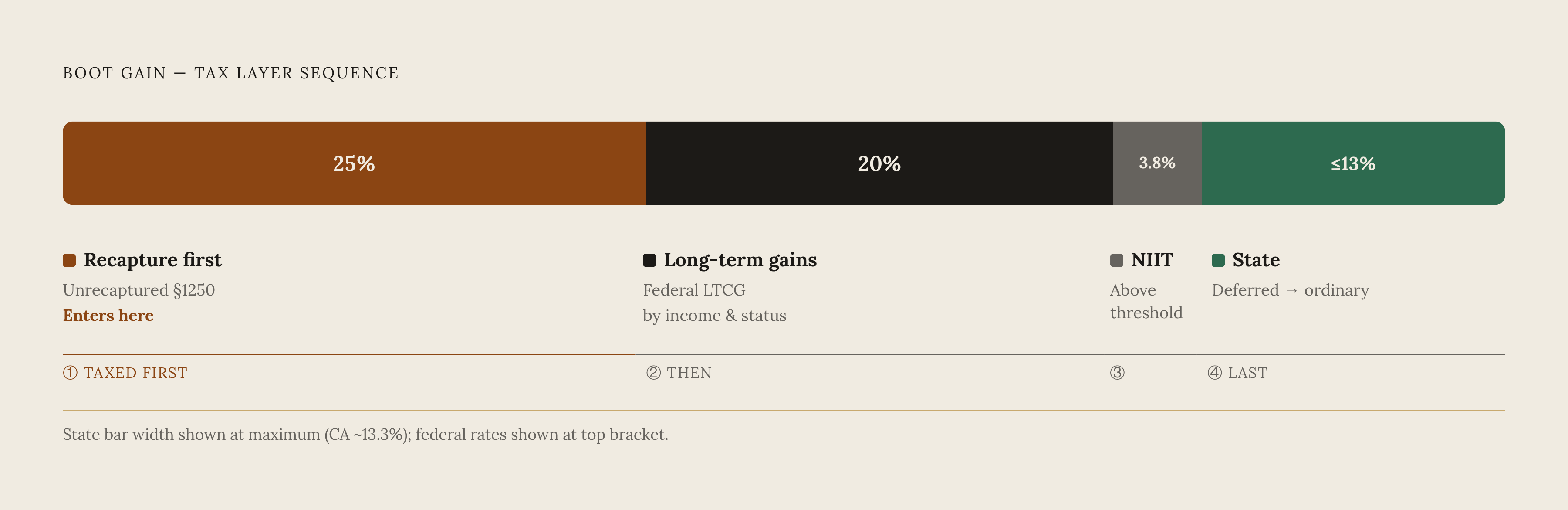
The sequencing rule matters here: recognized gain from boot gets allocated to depreciation recapture before it touches capital gain. Unrecaptured Section 1250 gain, the category covering accumulated depreciation on real property, carries a higher federal rate than long-term capital gain. And thanks to the "allowed or allowable" rule, this applies even to investors who never claimed depreciation on their returns. The IRS calculates recapture based on what the investor was entitled to deduct, not what they actually deducted, so skipping the deduction doesn't dodge the tax on the back end.
The practical result: an investor who's held a rental for years and pulls out a modest amount of cash boot may find that every dollar of it falls into the recapture bucket, taxed at the higher rate, rather than the lower long-term capital gains rate they were expecting. Full deferral avoids this entirely. It carries the accumulated depreciation forward into the replacement property's basis, and recapture waits until the investor eventually sells in a taxable transaction, if that day ever comes.
How total tax liability on boot stacks up across federal and state obligations
Federal long-term capital gains tax applies to whatever boot clears the recapture layer, at a rate that depends on the investor's income and filing status. On top of that sits the Net Investment Income Tax, which applies once income crosses the applicable thresholds and reaches gain recognized on investment property sales, boot included.
Because recapture is taxed at a higher federal rate than long-term capital gains, and because the sequencing rules push boot into the recapture bucket first, the effective rate on that first slice of boot often runs higher than investors expect going in.
Then there's the state layer, and it varies a lot. Some states follow federal 1031 treatment and defer state tax along with federal tax. Others impose their own capital gains tax at ordinary income rates, with no discount for long-term holding. Some states impose their own capital gains tax with no deferral benefit, so even a fully deferred federal exchange can trigger a meaningful state tax bill on the gain. Stack recapture rate, capital gains rate, the Net Investment Income Tax, and state tax together, and the effective rate on boot can land well above what an investor calculates by looking at the federal long-term capital gains rate alone. That stacking effect is exactly why advisors push clients to minimize boot even when the headline number looks small.
How boot is reported on Form 8824 and what a straddle-year exchange complicates
Form 8824 goes with the tax return for the year the relinquished property was sold, not the year the replacement property is acquired. It asks for descriptions of both properties, transfer and receipt dates, and any boot received; that boot figure flows straight into taxable income for the year.
Straddle-year exchanges add a layer of complication. When the relinquished property closes late in the year and the replacement doesn't close until the following year, the exchange still gets reported on the return for the year the relinquished property sold. But boot that isn't received until year two (say, leftover exchange funds disbursed after a January closing) may land on the year-two return instead, sometimes using Form 6252 for installment sale treatment. A failed exchange straddling two tax years can also qualify for installment sale treatment under IRC §453, spreading the recognized gain across both years rather than dumping it all at once.
There's a timing trap buried in here too. Investors who sell late in the year and don't file for a tax return extension can find their 180-day exchange window quietly cut short to the tax return due date, April 15, rather than running the full 180 days. And whatever basis gets recorded on the replacement property at the time of exchange needs to be right, because an error there doesn't just affect one tax year. It compounds through every depreciation deduction going forward and shows up again at the eventual sale.
Strategies investors use to reduce boot before the exchange closes
The most reliable way to avoid boot is also the simplest: buy up. A replacement property priced at or above the relinquished property's sale price, with all proceeds applied to the purchase, eliminates cash boot outright.
Debt works the same logic. Taking on equal or greater mortgage debt on the replacement side wipes out mortgage boot. An investor who genuinely wants to reduce debt can still avoid boot by adding cash to make up the difference, since cash offsets mortgage boot under the netting rules described earlier.
Closing costs matter more than most investors realize. Certain costs paid out of exchange funds (title insurance, recording fees, real estate commissions on the replacement purchase) reduce net proceeds and therefore reduce boot. Others don't qualify: loan fees, prorated property taxes, insurance premiums. Paying those from exchange funds doesn't reduce anything; it just creates cash boot by another name. Investors who identify multiple replacement candidates and then buy at the top of that range, rather than the bottom, also tend to leave less cash sitting unused after closing.
What doesn't work is worth stating plainly. Paying personal expenses out of exchange funds, shuffling leftover funds into a fresh exchange without ever buying a replacement property, or trying to hand boot back to the qualified intermediary after it's already been disbursed: none of it undoes the tax event. Once boot is received, it's recognized. And none of these strategies matter to an investor who wants the cash out in the first place; boot minimization is a tool for investors chasing maximum deferral, not a universal goal.
When accepting boot is the rational choice
Boot isn't always a mistake. Sometimes taking cash out of an exchange, taxable consequences and all, is the smarter move.
An investor who needs liquidity might find the tax cost on boot cheaper than the cost of borrowing against the property or unwinding a separate asset to raise cash. Someone looking to downsize into a smaller, lower-debt property might accept the tax hit because the other benefits (less management, less leverage risk) outweigh it. Capital loss carryforwards can absorb some or all of the recognized gain, turning what looks like a tax event on paper into something closer to a wash. And an investor simplifying a portfolio, consolidating properties, or stepping back from active management may find that even a partially deferred exchange beats a fully taxable sale by a wide margin.
The real question isn't whether boot exists. It's whether the after-tax cost of that boot beats the alternative: what a fully taxable sale would have cost, against what a partial exchange still manages to save. Partial deferral is still deferral. The gain that doesn't get taxed keeps compounding inside the replacement property, and that's worth something even when the boot check has already been cashed. The goal was never zero boot for its own sake; it's the right balance between cash in hand, tax exposure, and where the investor wants their capital to sit next.
The qualified intermediary's role in a partial exchange and what investors should verify
In a partial exchange, some of the money is always coming back to the investor eventually, and the qualified intermediary is the one holding it until then. The QI takes custody of sale proceeds during the exchange period and releases the boot portion at the appropriate time, while the rest gets applied to the replacement purchase.
Constructive receipt is the reason this role can't be skipped or shortcut. If the investor touches the funds directly during the exchange period, even briefly, the full exchange can lose its tax-deferred status. That's why the QI has to maintain strict, uninterrupted control over the funds until the exchange closes.
Fund segregation deserves real scrutiny before signing on with any intermediary. If a QI commingles client funds with its own operating accounts, and something goes wrong (insolvency, mismanagement, a dispute), recovering the investor's specific dollars gets complicated fast, and in the worst cases, impossible. Funds held in segregated accounts, identifiable to the individual investor rather than pooled with everyone else's, protect both the deferred portion of the exchange and the boot sitting there waiting to be disbursed. Before naming a QI, that's the detail worth confirming first, not last.