1031 Exchange Timeline Rules and Deadlines
Miss these two deadlines and your entire capital gains tax deferral vanishes instantly.
Section 1031 of the tax code lets an investor sell property held for business or investment and roll the proceeds into replacement property without paying capital gains tax at the time of sale. The mechanism works, but only if the investor honors a sequence of deadlines that Congress and the IRS have written with no built-in slack. Missing one date means the entire deferral collapses; the sale reverts to a taxable event, full stop.
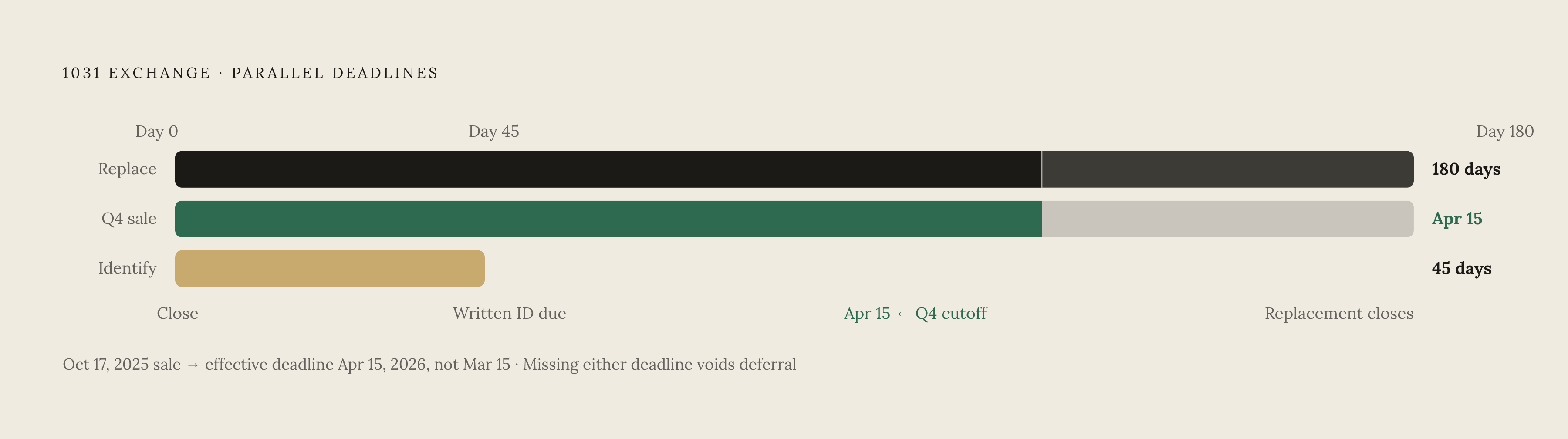
Both the 45-day and 180-day clocks start on the same day: the date the relinquished property transfers to the buyer, not the contract signing date and not the date funds clear. Day 45 is the hard deadline for delivering a written, signed identification of replacement property to the seller or another non-disqualified party in the exchange; the IRS grants no extensions for weekends, holidays, or slow title companies under normal circumstances. The replacement property must close by the earlier of day 180 or the investor's tax return due date for the year of the sale, which means a late-year closing can silently compress the 180-day window unless a filing extension is obtained before the exchange begins. Every exchange, regardless of outcome, is then reported on IRS Form 8824 on the tax return for the year the relinquished property was sold, even when the replacement purchase falls in the following calendar year.
Two master deadlines govern every exchange: 45 days to identify replacement property, and 180 days to close on it. Both clocks start on the same day, and since the Tax Cuts and Jobs Act of 2017, only real property qualifies for this treatment; personal property exchanges no longer get the benefit. What follows is the timeline in the order an investor actually experiences it, from the closing table to the tax return.
The moment the clock starts: closing on the relinquished property
Both the 45-day and 180-day periods begin on the date the relinquished property transfers. Not the date the contract was signed, not the date the investor learns the wire cleared. The transfer date, full stop.
This creates a sequencing problem that catches unprepared sellers off guard: the Qualified Intermediary has to be in place before that closing happens, not after. The QI must receive the sale proceeds directly. If the investor takes constructive receipt of the funds, even for a matter of hours, the exchange is disqualified, no exceptions. The exchange agreement and the QI engagement need to be signed and structured before the closing date, which means the decision to pursue a 1031 exchange has to happen well upstream of the sale, not as an afterthought once the wire has already landed in the seller's account.
Investors who decide, after the fact, that they'd like to defer the gain on a sale that already closed are out of luck. There's no retroactive fix. The QI holds the proceeds in a segregated account, and the investor cannot touch or direct those funds while they sit there; that separation of control is precisely what makes the exchange valid in the eyes of the IRS. Before closing day, an investor should already have a QI selected and engaged, an exchange agreement signed, and closing documents structured to route proceeds to the QI rather than to a personal or business account.
The 45-day identification window: what counts as a valid identification
The identification period ends at midnight on day 45, counted from the closing date of the relinquished property. There is no extension available under normal circumstances, and the IRS does not round up for weekends or holidays.
Identification has to meet a specific form. It must be in writing, signed by the taxpayer, and delivered to the seller of the replacement property or to another party in the exchange who isn't a disqualified person. A verbal mention to a broker doesn't count, and neither does an informal note sitting in a file somewhere.
Investors choose one of three identification rules, and the rules are mutually exclusive: pick one, and it governs the whole exchange. The 3-Property Rule allows identification of up to three properties of any value, with the requirement to acquire at least one; this is the rule most exchanges use in practice, largely because it's the simplest to satisfy. The 200% Rule permits identifying any number of properties, as long as their combined fair market value at the end of the identification period doesn't exceed twice the value of the relinquished property. The 95% Rule allows identifying any number of properties at any total value, but the investor then has to acquire at least 95% of what was identified, a bar high enough that it sees little practical use.
One underappreciated freedom in this window: identification can be revised at any point up to midnight on day 45. An investor can swap properties in and out of the list as due diligence turns up problems or as better opportunities surface, without penalty. That's the whole point of giving 45 days instead of, say, five; the window exists to allow real diligence, not just a formality. Investors who lock in their identification on day three because it feels efficient are giving away optionality for no reason.
It's also worth noting how wide the definition of "like-kind" actually runs in real estate. A single-family rental can exchange into a strip mall. Farmland can exchange into a Delaware Statutory Trust. An apartment building can exchange into raw land. The like-kind standard, as applied to real property, cares about the nature of the holding, business or investment use, not the type of asset.
The 180-day closing deadline and the tax-return trap that shortens it
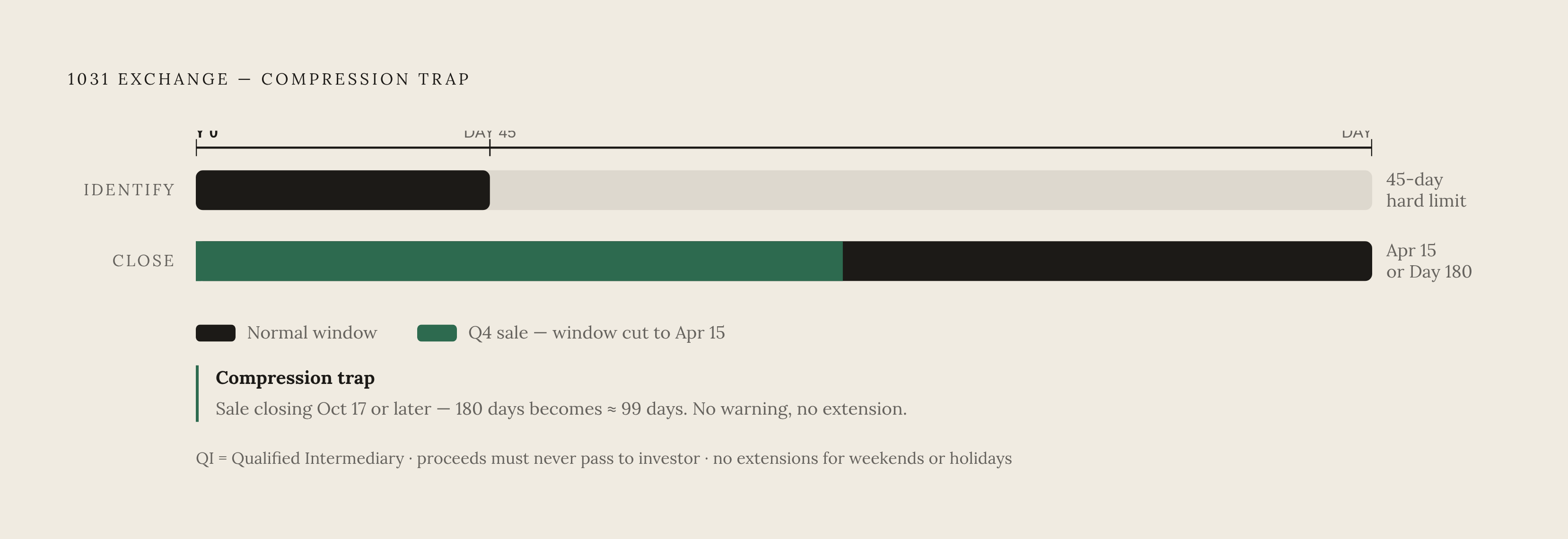
The replacement property has to close by the earlier of two dates: 180 days after the relinquished property transferred, or the due date of the investor's tax return for the year the relinquished property was sold. Most of the time, these two dates don't conflict. A sale in February or March runs its full 180 days without bumping into the following April 15 filing deadline.
Late-year sales tell a different story. Consider a sale that closes on or after October 17, 2025. Count forward 180 days, and the window lands after April 15, 2026, the standard filing deadline for the 2025 tax year. Without an extension, the exchange has to close by April 15, 2026, regardless of what the full 180 days would otherwise allow, which can shave weeks off the investor's timeline without any warning.
Filing a tax extension solves this. It pushes the return deadline out far enough to restore the full 180-day window for the exchange. What an extension does not do is extend the deadline to pay any tax owed; it only buys time on the paperwork. Investors closing in October, November, or December who skip the extension conversation can unknowingly compress their own exchange window, sometimes by a matter of months. Any Q4 relinquished-property sale should trigger an immediate call to a tax advisor about filing that extension, and that call needs to happen before the exchange starts, not in a panic in March.
When the IRS grants deadline extensions: the disaster relief precedent
Deadline extensions aren't theoretical. The IRS has granted them before, tied to federally declared disasters. Following the 2025 Southern California wildfires, the IRS extended both the 45-day and 180-day deadlines for affected taxpayers: any deadline that fell on or after January 7, 2025, moved to the later of October 15, 2025, or 120 days from the original deadline.
That relief extended not just to taxpayers directly hit by the fires, but to those who could show the disaster made it difficult to meet their deadlines, even without being classified as directly affected. It's a meaningful accommodation, but it's also narrow by design.
These extensions are case-by-case, tied to specific federally declared disasters, and issued by the IRS on its own timeline. An investor cannot petition for a personal extension because a lender was slow or a title company had a bad week. Standard planning has to assume no extension will be available, ever. Disaster relief exists as emergency backstop, not as something to build a timeline around.
How exchanges that span two tax years get reported to the IRS
Every 1031 exchange gets reported on IRS Form 8824, whether or not any gain ends up recognized. The filing requirement doesn't depend on the outcome; it depends on the transaction having occurred.
The reporting rule that trips people up involves exchanges that straddle December 31. The entire exchange gets reported on the tax return for the year the relinquished property was sold, not the year the replacement property was acquired. A sale that closes in July 2024, with a 180-day window running into early 2025, gets reported on the 2024 return, even though the replacement purchase happens in the following calendar year.
This creates an odd sequencing problem for Q4 sellers. They may need to file, or extend, their return before the exchange has actually finished, yet the return still has to reflect the exchange as complete for that tax year. Reporting on the wrong year, or skipping Form 8824 altogether, invites IRS scrutiny even when the underlying exchange was structured correctly. Any exchange that crosses December 31 is a strong signal to bring in a tax advisor who works with 1031 mechanics regularly, before the filing goes in, not after a notice arrives.
The role of the Qualified Intermediary in keeping the timeline intact
A QI isn't a convenience; it's a requirement. Without a QI and a signed exchange agreement in place before the relinquished property closes, the IRS won't recognize the transaction as a valid exchange at all, regardless of intent.
The QI's job runs through the whole timeline: holding funds, drafting exchange documents, coordinating with closing agents, and, when needed, delivering the identification notice on the investor's behalf. Several failure modes at the QI level can unravel an otherwise well-planned exchange: no exchange agreement signed before the sale closes, the investor being allowed to touch the funds even briefly, a mishandled identification document, or an administrative delay that pushes the replacement closing past day 180.
Here's the part investors are often surprised to learn. QIs face no federal licensing requirement and no federal regulatory oversight, unlike a bank or a securities firm. So if a QI mishandles or misappropriates exchange funds, there's no federal safety net waiting to make the investor whole. The clearest illustration of this exposure is the LandAmerica bankruptcy: when the company became insolvent, courts determined that exchange funds held by its subsidiary were corporate assets, not client assets, and written performance guarantees offered no legal recourse to the investors who'd trusted those funds to the firm.
Selecting a QI, then, is a fund-security exercise as much as a service selection. Funds should sit in segregated accounts, never commingled with the QI's own operating capital. The QI should carry fidelity bond coverage and errors-and-omissions insurance. A verifiable track record with exchanges similar to the one at hand matters, as does transparent reporting that lets the investor check account status throughout the 45-to-180-day period rather than trusting a black box. Membership in an organization like the Federation of Exchange Accommodators is a reasonable signal, though not a guarantee on its own. QIs that voluntarily submit to outside regulatory examination, through a state banking division, the OCC, or the Federal Reserve, offer a materially higher baseline of fund safety than those operating with no external check at all.
What QI fees actually cost, and what investors are often not told about interest on held funds
A standard delayed exchange runs $750 to $1,500 in QI fees. Complex exchanges, involving multiple properties or reverse structures, run $2,000 to $5,000 or more. Those numbers, on their own, tell an incomplete story.
Setup and administration fees make up only about a fifth to a quarter of a typical QI's revenue. The bulk comes from somewhere the investor rarely hears about upfront: interest earned on the exchange funds while they sit with the QI during the 45-to-180-day window. Most traditional QIs keep that interest in full, and it's rarely disclosed as a cost to the client, even though it functions exactly like one. On a large exchange, where the held balance runs into seven figures for months at a stretch, that retained interest can exceed the stated fee by a wide margin.
A newer model has emerged that flips this arrangement. A growing number of QIs charge no upfront fee for a standard delayed exchange and instead share the interest earned on held funds with the investor, rather than keeping it, with balances held in segregated, FDIC-insured accounts. The economics work because technology-driven administration cuts overhead low enough that the interest income, split with the client, still covers operating costs.
None of this means the traditional fee-based model is unreasonable. Investors with a large share of net worth tied up in real estate often view a flat fee as a fair price for the assurance of working with an established firm. The fee question and the fund-security question aren't separable, though; evaluating a QI means looking at the stated fee and asking, directly, what happens to the interest on held funds. Retained, shared, or credited back: the answer to that question is half the true cost of the exchange, and it rarely appears on the fee schedule.
What must an investor have in place before the 1031 exchange clock starts?
Before the relinquished property closes, and before the 45-day clock even starts ticking, a short list of items needs to be settled.
The QI should be vetted and engaged, with the exchange agreement signed ahead of closing. Closing documents need to route sale proceeds directly to the QI, never to the investor. The identification strategy, meaning which of the three rules applies and how many candidate properties are under consideration, should be decided in advance rather than worked out under deadline pressure. Both the day-45 and day-180 dates belong on a calendar the moment a closing date is projected, not after the fact.
For anyone selling after mid-October, a conversation with a tax advisor about filing an extension should happen before the exchange begins. For anyone whose exchange will cross December 31, the same advisor needs to confirm how and when the transaction gets reported on Form 8824. Fund security deserves direct confirmation: segregated accounts, fidelity bond and E&O insurance, and reporting the investor can actually see. The QI's interest policy should be asked about explicitly, in writing, rather than assumed.
By day 30, a backup identification should already exist, in case the primary deal falls apart in due diligence; waiting until day 45 to build a fallback plan leaves no room for error. Financing for the replacement property should be underway well before that point too, since lenders move at their own pace, and the 180-day window does not pause for anyone's mortgage approval.