Qualified Intermediaries That Charge No Fees for 1031 Exchanges
No-fee intermediaries waive transaction costs but earn money through escrow interest instead.

A 1031 exchange lets an investor sell property, reinvest the proceeds, and defer capital gains tax under Section 1031 of the tax code. That deferral only works if a Qualified Intermediary handles the money in between, and at least one QI now charges nothing to do it. Understanding how a no-fee QI earns a living, and what happens to the interest on the cash sitting in escrow, is the difference between picking a good deal and missing a hidden one.
Why a Qualified Intermediary is not optional, and what one actually does
The IRS rule that makes 1031 exchanges work also makes them fragile. Constructive receipt is the trip wire: if an investor touches, directs, or benefits from the sale proceeds at any point between closing on the old property and closing on the new one, the exchange collapses into a taxable sale. It doesn't matter if the money passes through the investor's account for a single afternoon. Once it's within reach, the deferral is gone.
That's the entire reason a QI exists. The intermediary holds the sale proceeds in a segregated account, takes on the contractual role of buyer and seller at each leg of the transaction, and keeps the investor legally at arm's length from funds that would otherwise disqualify the exchange. A specific tax regulation covering like-kind exchanges spells out the safe harbor: the QI enters a written Exchange Agreement, acquires the relinquished property from the exchanger, transfers it to the buyer, then acquires the replacement property and transfers it back. Skip any of those steps, or let the investor near the cash, and the safe harbor doesn't apply.
Christensen v. Commissioner shows what happens when that structure breaks down. The Tax Court found the taxpayer had direct access to the exchange proceeds, which invalidated the exchange entirely and triggered immediate taxation on the full gain. The lesson isn't subtle: the QI has to be engaged before the relinquished property closes, and the sale proceeds need to flow straight into the exchange account, never through the investor's hands, not even briefly.
Here's the part that catches people off guard. There's no national licensing requirement for Qualified Intermediaries. Anyone can print business cards and call themselves one. Some states may impose their own rules, but there's no federal body vetting who's allowed to hold six or seven figures of someone else's sale proceeds for months at a time. The tax code does bar certain people from serving as QI, specifically attorneys, accountants, or financial advisors who've performed non-exchange-related services for the investor, since that's considered too close a relationship to trust with the funds. But outside that narrow disqualification rule, due diligence on who's actually holding the money falls entirely on the investor.
That gap matters more once you start asking how these companies make money.
How traditional QIs make money: fees upfront and interest in the background
Most QIs earn revenue two ways, and only one of them is visible on the invoice. The first is a straightforward transaction fee, usually a flat charge for a standard forward exchange, running anywhere from a few hundred dollars to over a thousand, with complex deals (reverse exchanges, multiple relinquished or replacement properties) climbing into the thousands. Additional properties on either side of the exchange typically add per-property charges on top of the base fee.
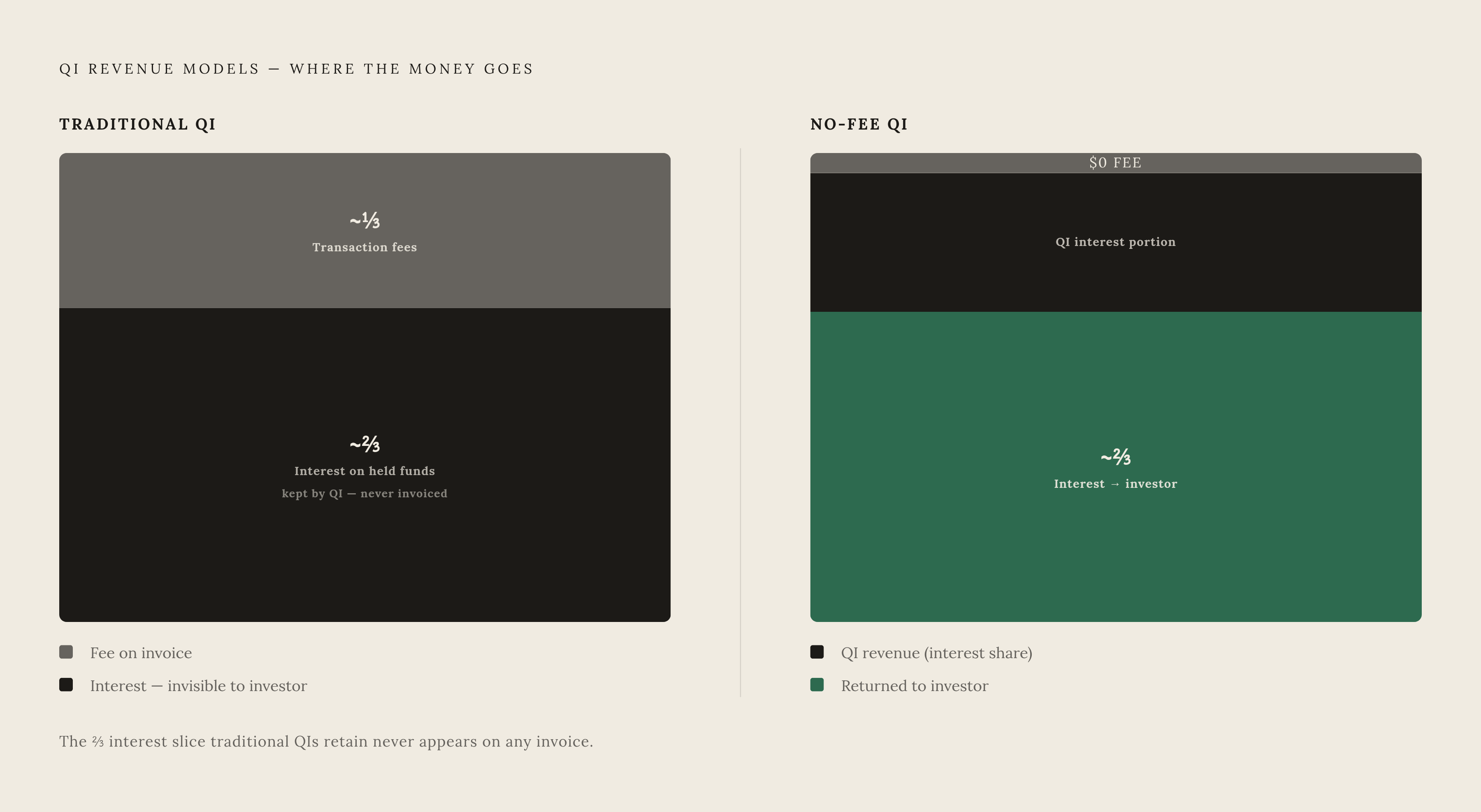
The second revenue stream is quieter and, by most industry accounts, considerably larger: interest on the held funds. Exchange proceeds can sit in the QI's account for up to 180 days, and during that window, the money earns interest. Industry analysis suggests that interest income accounts for roughly two-thirds of a typical QI's revenue, with the stated transaction fee making up only about a third. On a exchange involving a few hundred thousand dollars held for five or six months, that interest is not pocket change, and in many traditional arrangements, the QI retains the bulk of it.
This is the part that a sales conversation rarely discloses. An investor comparing quotes usually looks at the fee line, sees one flat-dollar quote noticeably higher than the other, and picks the cheaper one, without ever asking what happens to the interest on the underlying funds. Fee structures vary too: flat fee, percentage of transaction value, or some hybrid of the two. Percentage-based fees deserve particular scrutiny, since they scale with deal size even though the actual administrative work, opening an account, drafting the exchange agreement, coordinating closings, stays roughly the same regardless of whether the exchange involves a modest sum or an amount many times larger.
There's a technical wrinkle here too. QI service fees are generally "qualifying" costs that can be paid directly from exchange proceeds without triggering boot or immediate tax consequence. Certain other closing costs may not qualify and could have to be handled separately. That qualifying status doesn't make the QI fee free, though. It just means the fee gets absorbed into the exchange rather than billed separately, which is exactly why so few investors notice how much they're actually paying.
Put the fee and the interest together, and the real cost of a traditional QI relationship looks very different from the number on the engagement letter. That gap is what makes the real cost of the no-fee model different from what a traditional QI relationship's engagement letter number suggests.
How no-fee QIs work: the revenue model that makes $0 exchange fees possible
The no-fee model flips the traditional arrangement. Instead of charging an upfront fee and keeping all the interest on held funds, these QIs waive the transaction fee and earn revenue from the interest instead, often sharing a portion of that interest back with the investor rather than retaining the entire amount.
Two things make this workable rather than a loss leader. First, software has taken over much of the manual administrative overhead that used to justify charging a flat fee: document generation, fund tracking, deadline monitoring. Lower operating costs mean a QI doesn't need the fee revenue to stay solvent. Second, the interest earned on aggregated exchange funds, held across many client accounts simultaneously, provides enough revenue on its own to cover costs and still leave a share for the investor whose money is actually generating it.
Deferred is one operator running this model. It charges $0 for a standard forward exchange and holds client funds in segregated, FDIC-insured accounts with coverage up to a substantial cap. Rather than charging a fee, it retains a portion of the interest earned on held funds to cover its costs and shares the remainder with the investor. Exchanges can be opened in a matter of minutes, including on the same day as closing, and each file is handled by dedicated staff rather than getting passed between a sales rep and a processing team. Interest rates are published in an open rate table rather than negotiated case by case, and support runs seven days a week until midnight ET.
Engineered Tax Services runs a comparable structure through its Engineered 1031 Exchange offering: no exchange fee, funds placed in interest-bearing accounts, and the interest shared with the investor rather than retained by the firm. Technology absorbs the cost that would otherwise justify a fee, and the savings get passed along.
The detail that separates these two from a QI that merely advertises "no fee" is the interest-sharing piece. A QI can waive its transaction fee and still keep all of the interest on held funds, which isn't really a discount at all, just a different label on the same economics. Sharing interest is what actually changes the deal for the investor.
This segment remains small relative to the overall QI market, and it hasn't become the industry standard. On its own terms, the incentive structure it creates is such that a QI whose revenue depends on holding funds at a competitive rate for the full exchange period has more reason to see the exchange through smoothly than one that collects a flat fee regardless of how the transaction plays out. That said, the no-fee model doesn't shrink the legal workload. Every function required under the safe harbor rules, the written agreement, the title transfers, the fund segregation, still has to happen exactly as it would with a traditional QI. The savings come from overhead, not from cutting corners on compliance.
What investors actually gain when the fee and interest picture changes
Two separate gains appear in this comparison, and they shouldn't be collapsed into one. The first is the obvious one: no transaction fee, which on a standard forward exchange might save several hundred to over a thousand dollars. The second, and often larger, gain is the interest income that a traditional QI would have simply kept. On a sizable exchange held close to the full 180-day window, that interest can add up to a meaningful sum, scaling directly with both the size of the deal and how long the funds stay parked.
Deferred's structure includes a detail that breaks from how the traditional model handles cancellations: the interest-sharing structure applies throughout the exchange period, a distinction worth confirming directly with any QI before signing. That's a structural distinction, not a marketing line. If an exchange collapses, investors should confirm in advance exactly what happens to any fee paid and any interest earned, since QI policies on both points vary.
Transparency plays a role here too, and it's easy to undervalue. A published rate table, the kind Deferred maintains publicly, tells an investor exactly what interest rate applies before signing anything, with no back-and-forth negotiation and no waiting on a phone call to find out. That kind of disclosure cuts down the due-diligence burden considerably, since the investor isn't left guessing what the QI is quietly earning off the account.
None of this is one-time value, either. Section 1031 places no cap on how many times an investor can execute an exchange, and investors who roll gains from one property into another across multiple transactions over the years compound these savings each time. A few hundred dollars in avoided fees and a share of interest income might look modest on a single exchange. Across five or six exchanges over a decade, the numbers stop looking modest.
What to verify before choosing a no-fee QI, or any QI
Fund security comes first, and it isn't negotiable. Confirm the funds sit in a segregated account, kept separate from the QI's own operating funds, and ask what the FDIC coverage limit actually is relative to the size of the exchange. Deferred, for instance, holds funds in FDIC-insured segregated accounts, and any QI should be asked to specify what coverage limit applies to the exchange size in question. Investors should also check whether the QI carries a fidelity bond or errors-and-omissions insurance, since that coverage is what stands behind the investor's funds if something goes wrong operationally.
Interest terms need the same scrutiny. Does the QI share interest with the investor, keep all of it, or offer some negotiated split? Is the applicable rate published somewhere an investor can see it before signing, or does it only become clear after a phone call? A QI unwilling to put a rate in writing ahead of time is asking for trust it hasn't earned.
Who actually handles the file matters more than it sounds. A dedicated senior Exchange Officer who stays on the file from the first call through the final closing is a fundamentally different experience than a commissioned salesperson who closes the deal and vanishes, leaving the paperwork to a processing team with no ongoing accountability. That handoff is where mistakes occur.
Speed and availability round out the practical checklist. Real estate closings don't respect business hours, so confirm the QI can open an exchange on short notice, including the same day as closing, and check whether support extends to evenings and weekends. Confirm too that the QI actually handles the specific exchange structure needed. A forward exchange is one thing; a reverse exchange or a construction/improvement exchange is a different animal entirely, and not every QI that waives fees on a standard forward exchange is equipped for the more complex versions.
Given the absence of federal licensing, the burden of verification sits with the investor, not with a regulator. Check the QI's BBB rating, read client reviews, look for any history of regulatory action or client fund losses. For no-fee QIs specifically, confirm the $0 applies to the exchange type actually being used, and ask directly whether extra properties, wire transfers, or a cancelled exchange trigger charges that weren't mentioned upfront.
None of this due diligence can happen after the relinquished property has already closed. The QI has to be in place, funds already directed to the exchange account, before that closing occurs, which means the entire evaluation process outlined above needs to happen on a clock that starts well before most investors think to start it. Deferred.com, a no-fee 1031 Qualified Intermediary that shares interest earned on held funds directly with the investor and can open an exchange in as little as five minutes, is one concrete option to evaluate against that checklist.