Reverse 1031 Exchange Process and Requirements
Buying replacement property first requires parking it with a third party until the sale closes.
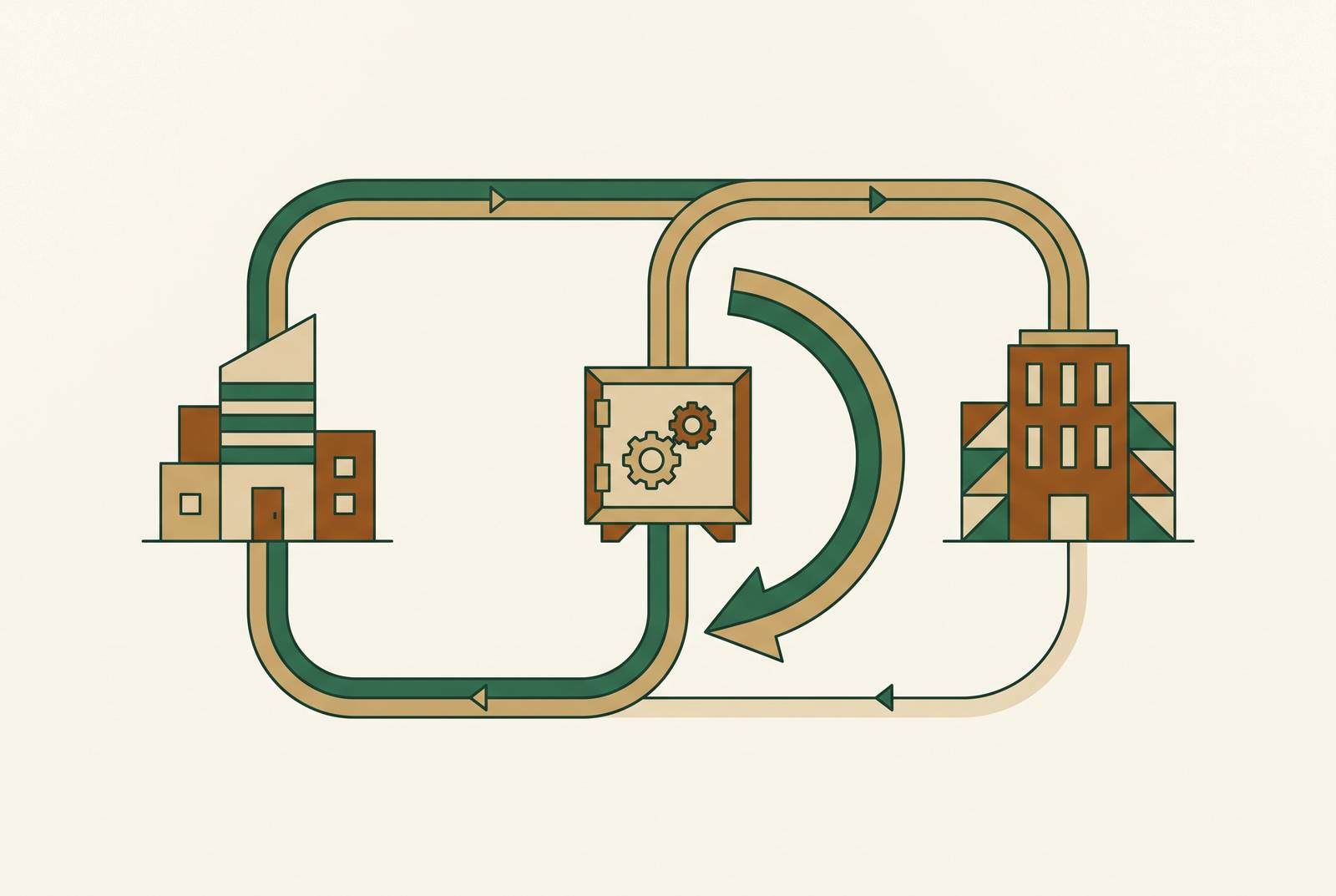
The mechanism matters more than the marketing here: a reverse 1031 exchange lets an investor buy replacement property before selling the property they're giving up, flipping the usual order of a like-kind exchange. It exists because forward exchanges require selling first and buying second, and real estate deals rarely wait around for that sequence to line up on schedule.
The fundamental situation
Picture an investor who's held a duplex for eight years and stumbles onto a fourplex two blocks over that's priced right, cash-flows well, and won't sit on the market. The duplex isn't even listed yet. Under a standard forward exchange, that timing kills the deal: Section 1031 of the Internal Revenue Code only defers gain if the investor identifies and closes on replacement property after disposing of the relinquished one, inside the standard 45 and 180-day windows. A forward exchange has no mechanism to buy first. A reverse exchange does, and that's the entire reason it exists.
Section 1031 itself is narrow but generous. No gain or loss gets recognized when a taxpayer exchanges real property held for productive use in a trade or business, or for investment, for other like-kind real property, and "like-kind" for real estate is defined broadly. A warehouse can trade for an apartment building, raw land can trade for a retail strip, so long as both sides are U.S. investment or business property. The asset type barely matters. The timing is everything.
The rule that makes reverse exchanges structurally different from their forward cousins is simple to state and hard to work around: the IRS won't let an investor own both the relinquished and replacement properties at the same time during the exchange. Somebody else has to hold title to one of them while the exchange is in motion. That single constraint is what forces an Exchange Accommodation Titleholder into existence, standing between the investor and one of the two properties. The next section covers that structure in detail.
Investors reach for this when a market moves fast enough that a good replacement property won't wait for a sale to close, when a seller on the other end demands a quick or unconditional closing, or when someone wants to lock down a property before conditions shift underneath them. Forward exchanges remain what most investors use, by a wide margin, and that's the right default: reverse exchanges cost more, take more coordination, and should be a fallback for a specific timing problem, not a first choice. They're well established under IRS guidance, not an improvised workaround, but they're a tool for a narrow situation.
The legal foundation: Rev. Proc. 2000-37 and the safe harbor framework
Reverse exchanges sat in a gray zone for years before the IRS gave them formal footing. Practitioners structured them, accepted the risk, and hoped for the best, because no published guidance said whether or how the IRS would respect the arrangement. Rev. Proc. 2000-37, issued in 2000, changed that. It built a safe harbor: meet its conditions, and the IRS will presume the Exchange Accommodation Titleholder, not the investor, is the legal owner of the parked property for tax purposes.
That presumption is the whole point. Without it, the IRS has an opening to argue the investor constructively owned both properties at once, which unravels the exchange and triggers the very tax bill the investor was trying to defer.
The document that makes the safe harbor operative is the Qualified Exchange Accommodation Arrangement, or QEAA, a written agreement between the investor and the EAT. It has to be executed before the EAT takes title, or within five business days after. Miss that window and the exchange doesn't automatically die, but the investor loses the safe harbor's presumptions and is left arguing the facts of ownership from a much weaker position.
Rev. Proc. 2000-37 preserves more flexibility than most investors expect, and that's worth stating plainly because the restrictions people assume exist mostly don't. The investor can loan money to the EAT, even at zero interest. The investor can guarantee a third-party loan taken out by the EAT. The investor can lease the parked property back from the EAT without paying anything close to market rent, and can manage construction, act as general contractor, and run the property day-to-day. The QEAA can even include puts and calls that let the investor take the property at a fixed price down the road. None of that ownership-adjacent activity disqualifies the arrangement, so long as the paperwork and structure meet the safe harbor's terms.
Not everyone can serve as the EAT. The rule excludes the taxpayer and any "disqualified person," a category that includes the investor's employee, attorney, accountant, or real estate broker. In practice, the EAT holds title inside a single-member LLC set up specifically for the transaction, a special-purpose entity created and dissolved around this one deal. That's not an optional refinement. It's standard, and any QI who suggests otherwise is cutting a corner that shouldn't be cut.
One detail trips up more investors than it should: there are two separate 180-day periods, the parking period under Rev. Proc. 2000-37 and the exchange period under IRC Section 1031, and they run independently of each other. Satisfying one doesn't satisfy the other. Both have to close out cleanly, on their own terms.
The same safe harbor also covers improvement exchanges, which matter because exchange funds can't legally be used to improve property the investor already owns. The EAT holds title while construction happens, using exchange funds to fund the improvements, then conveys the finished property to the investor once the work is done and the exchange completes.
The five-step sequence of a reverse exchange
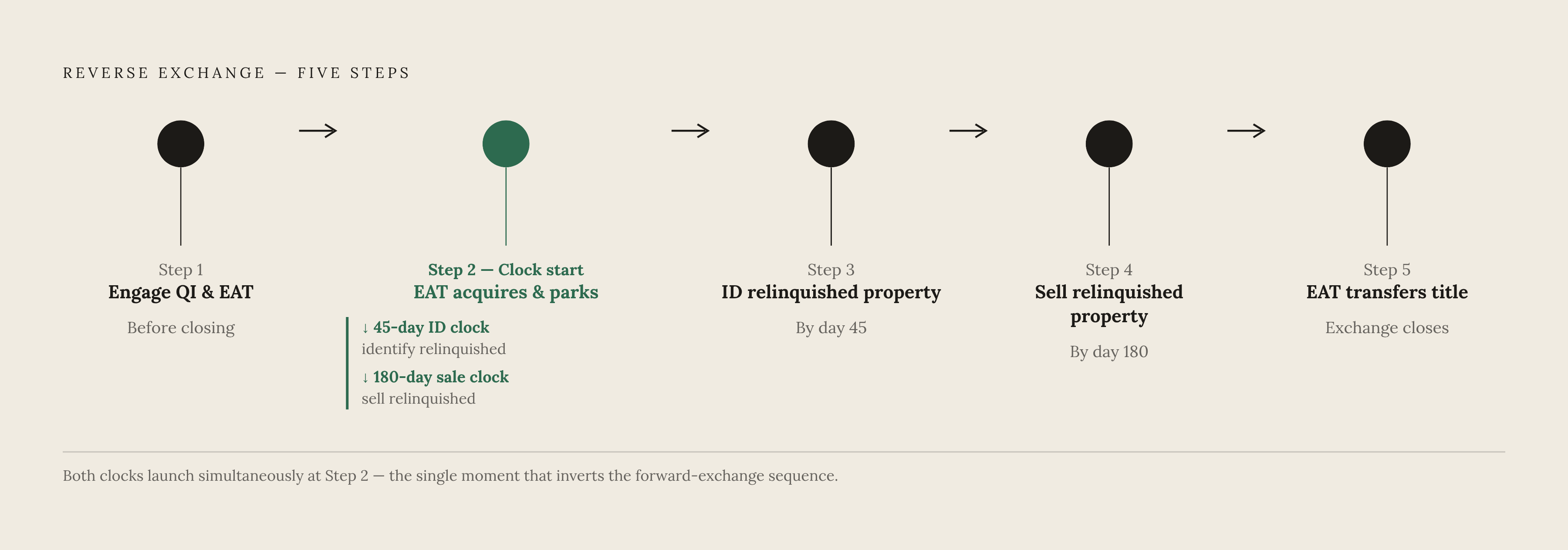
Step 1: Engage the QI and EAT before anything closes. This is the single timing decision that determines whether the whole exchange stands or falls. The Qualified Intermediary and the EAT need to be lined up and the structure built before the replacement property closes, not after. An investor cannot buy the replacement property first and then retroactively set up a reverse exchange around it: that sequence doesn't qualify, full stop, no matter how good the intentions were. The QI drafts the exchange documents in advance, and the EAT has to be ready to take title the moment closing happens. The QEAA itself must be signed before the EAT takes title, or within five business days after.
Step 2: The EAT acquires and holds the replacement property. At closing, title goes to the EAT, not the investor, inside that purpose-built single-member LLC. This is the "parking" arrangement the whole framework is named for: the property sits with the EAT until the investor's relinquished property sells and the exchange can complete. The day the EAT takes title is the day both the 45-day and 180-day clocks start ticking, simultaneously.
Step 3: Identify the relinquished property within 45 days. The identification logic runs backward from what most people expect. In a forward exchange, you identify what you're buying. In a reverse exchange, you identify what you're selling, on or before midnight of the 45th day after the EAT takes title. That written identification has to be unambiguous and delivered to another party in the exchange, typically the EAT or the QI. The same three-property and 200% identification rules that govern forward exchanges apply here too. Miss the 45-day mark and the exchange isn't automatically dead, but the safe harbor protections evaporate, leaving the investor exposed on the basic question of who owned what and when.
Step 4: Sell the relinquished property within 180 days. The clock runs from the same day the EAT took title to the replacement property, and the sale has to close by day 180. Both 180-day obligations, the parking period and the Section 1031 exchange period, need to be satisfied, since they're independent requirements rather than one clock wearing two names. During this stretch the investor commonly leases the parked replacement property back from the EAT and manages it as though it were already theirs. Financing on the relinquished-property side and the loan structure backing the EAT both need careful coordination through this window: a hiccup in either one can knock the whole timeline off track.
Step 5: Transfer title and close the exchange. Once the relinquished property sale closes, the EAT transfers title of the replacement property to the investor, the special-purpose LLC's role concludes, and exchange funds move according to the QI's documentation. At this point the like-kind requirement gets confirmed one last time: both properties have to have been held for investment or business use throughout, not just at the moment of closing.
The timelines in detail and what happens when they slip
The 45-day deadline for identifying the relinquished property runs to midnight of day 45, no extensions, no exceptions built into the safe harbor itself. The 180-day deadline for closing the relinquished property sale and transferring the parked replacement property runs to midnight of day 180. Those numbers aren't guidelines. They're hard boundaries, and treating them as soft targets is the single most common mistake in this entire process.
Missing either deadline doesn't automatically disqualify the exchange, but what actually happens is narrower and, in its own way, worse: the investor loses the presumptions the safe harbor was built to provide. Once that happens, the arrangement gets judged on a facts-and-circumstances basis, meaning the IRS or a court looks at whether the EAT genuinely held the benefits and burdens of ownership, or whether the investor functionally controlled the property the whole time. That standard is subjective, fact-dependent, and litigable, which is precisely the outcome Rev. Proc. 2000-37 was written to help investors avoid.
The two independent 180-day clocks catch people off guard more than any other part of this process. Both start the day the EAT takes title. Both have to be satisfied. Satisfying one says nothing about the other, and an investor who assumes there's a single 180-day window to track can end up compliant on one front and exposed on the other.
Timing failures also create boot risk. Any proceeds from the relinquished property sale that don't get reinvested into like-kind replacement property count as boot, and boot is taxable. For full deferral, the replacement property's value has to equal or exceed the relinquished property's value. Fall short, and the difference gets taxed as gain even though the rest of the exchange went through cleanly.
No extensions exist for any of these deadlines outside a narrowly defined set of circumstances such as a federally declared disaster. Everything else has to fit inside 45 and 180 days. The practical lesson, then, is to build slack into the relinquished property's sale timeline well before the clock even starts. Listing delays and slow closings are a frequent and preventable reason reverse exchanges run into trouble with the 180-day window.
The financing challenge that catches reverse exchange investors off guard
The replacement property sits in the EAT's name, not the investor's, and that single fact knocks out a large share of conventional lenders before the conversation even starts. Most residential lenders, and plenty of commercial ones, aren't set up to underwrite a loan against an entity created for a few months and dissolved once the exchange wraps. The legal structure that protects the exchange for tax purposes is the same structure that makes a loan officer nervous, and investors who assume their existing lender relationship will just carry over into a reverse exchange are the ones who get blindsided two weeks before closing.
Paying cash through the EAT is the cleanest path, but it demands liquidity the investor may not have until the relinquished property actually sells. Rev. Proc. 2000-37 explicitly permits the investor to loan funds directly to the EAT, interest-free if the parties want, which sidesteps the lender problem entirely. The investor can also guarantee a third-party loan made to the EAT, another arrangement the safe harbor blesses outright. Where none of that works, bridge or hard-money financing fills the gap, though rates in that space run roughly 8% to 12% annually as of 2026, and that cost compounds fast if the relinquished property takes several months to sell.
Portfolio lenders and commercial lenders tend to have more room to work with EAT structures than conventional residential lenders do. Finding one with actual reverse-exchange experience isn't a nice-to-have: it's the difference between a financing plan that survives underwriting and one that collapses right before closing. The financing has to be locked in before the EAT takes title, since there's no retroactive fix once the clock starts. Investors without enough liquidity, or without a lending relationship already in place, need to sort that out before starting the exchange, not while it's already underway. Waiting until the parking period begins to shop for a lender is a mistake that can easily derail an otherwise well-structured exchange.
What a reverse exchange costs and how to evaluate whether it's worth it
A standard forward delayed exchange runs $750 to $1,500 in QI fees, a cost most investors treat as a rounding error against the tax deferred. A reverse exchange is a different animal, and the price tag reflects that.
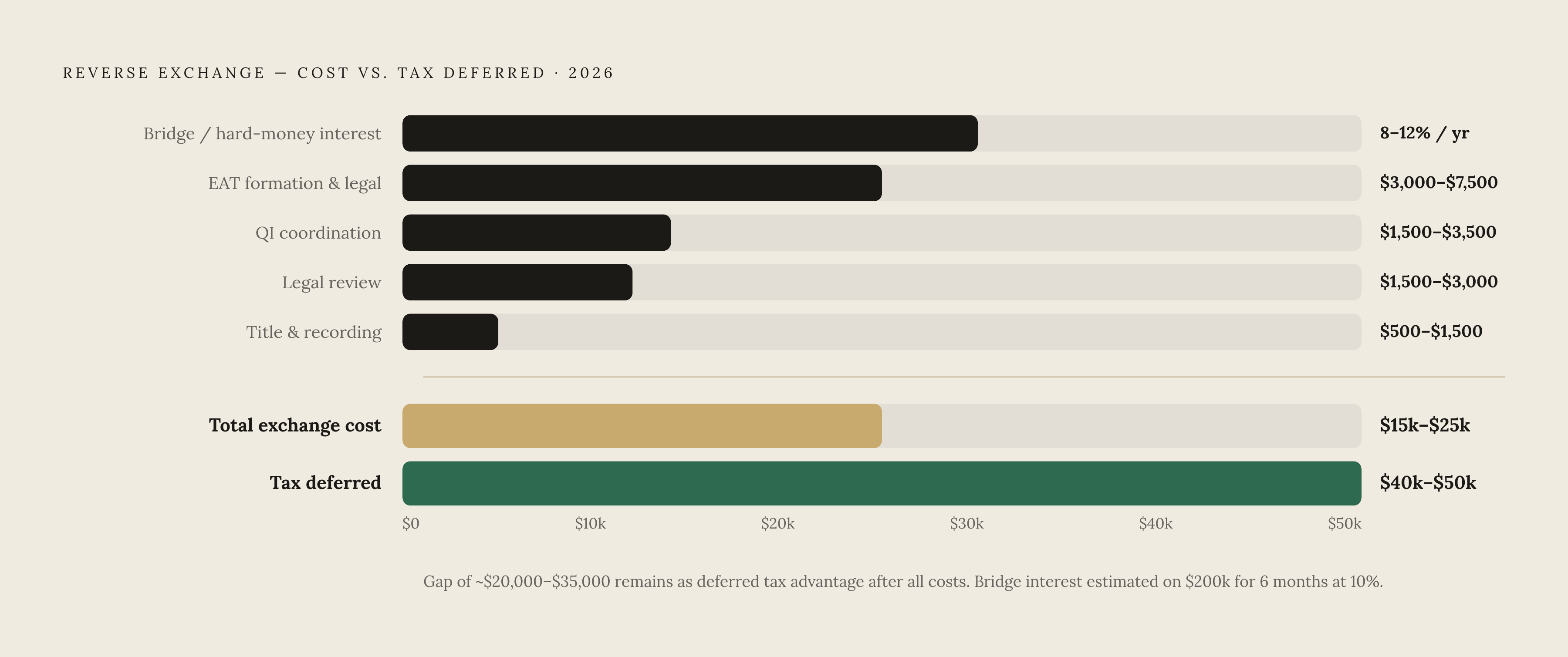
Breaking down the cost stack for 2026: QI fees for coordinating the exchange and preparing documentation run $1,500 to $3,500. Setting up and holding the EAT, including entity formation and the legal work behind it, runs $3,000 to $7,500. Legal review of the exchange agreement, the EAT's operating agreement, and any lease-back arrangement adds another $1,500 to $3,000. Title and recording fees for the extra transfer, since the property changes hands twice instead of once, run $500 to $1,500. And if conventional financing isn't available, bridge or hard-money interest adds another 8% to 12% annually on top of everything else.
Add it up and a reverse exchange typically lands at $15,000 to $25,000 all in, according to figures from Taxstra. A narrower estimate from Lineage, looking just at intermediary fees rather than the full cost stack, puts that piece alone at $3,500 to $7,500 or more, roughly two to four times what a standard forward exchange costs on the intermediary side.
That number needs context to mean anything, and the context makes the decision easier than most investors think. On a property carrying $200,000 in capital gains, combined federal and state tax exposure could reach $40,000 to $50,000 if the gain isn't deferred. Set against that, a $15,000 to $25,000 cost to defer $40,000 to $50,000 in tax isn't a marginal call. It's a clear win in most scenarios where the exchange executes cleanly, and the investors who talk themselves out of a reverse exchange purely on sticker shock are usually doing the math wrong.
Some providers that charge nothing for standard forward exchanges, sharing interest income with the investor instead of billing fees, do charge for reverse exchanges, often several thousand dollars or more depending on complexity. That's not inconsistency. The EAT structure, the legal coordination, and the extra closing transfers genuinely require more work than a forward exchange does, and the fee reflects that reality rather than an inflated price.
Investors should ask any QI for a full fee disclosure before signing anything. Add-on charges, wire fees, rush fees, fees for identifying extra properties, show up often enough in forward exchanges, and they compound further once a reverse structure's added complexity gives a provider more line items to bill against. Choosing a QI purely on the lowest quoted price is the wrong instinct here, and it's worth saying without qualification: a reverse exchange that fails on a procedural technicality, a missed identification deadline or sloppy QEAA drafting, wipes out the entire tax deferral. No fee savings comes close to offsetting that loss.
Selecting a QI for a reverse exchange and what to look for
Reverse exchanges ask more of a Qualified Intermediary than forward exchanges do. Someone has to coordinate the EAT, draft and execute the QEAA inside a five-business-day window, and produce documentation that can hold up if the IRS ever looks closely at who really controlled the parked property. Not every QI that handles forward exchanges competently is equipped to do this well, and assuming otherwise is the mistake that shows up in botched QEAAs and blown deadlines.
The first question worth asking is blunt: how many reverse exchanges has this firm actually completed, and has the specific person handling the file done one before? Forward exchange volume doesn't translate automatically into reverse exchange competence. The mechanics, the deadlines, and the failure points are different enough that experience in one doesn't guarantee skill in the other. A QI should be able to walk through the EAT coordination process in specific terms, not gesture vaguely at "handling everything," and a vague answer to that question is a reason to keep looking.
Given how much rides on the QEAA being executed correctly and on time, and on the 45 and 180-day clocks being tracked without slippage, the difference between a QI who's done this many times and one who's improvising shows up exactly when it matters most: at the deadlines that don't bend.