1031 Exchange Property Identification Rules
Missing the identification rules can void your entire tax deferral.

A 1031 exchange lives or dies on a set of identification rules that most investors never read until they are already inside the 45-day window, scrambling. The exchange itself is straightforward in concept: sell investment or business real property, roll the proceeds into like-kind replacement property, and defer capital gains tax, depreciation recapture, and net investment income tax on the transaction. It is not a loophole. Section 1031 has existed in the tax code since 1939, and the Tax Cuts and Jobs Act of 2017 narrowed it specifically to real property, closing off the personal property and equipment exchanges that used to qualify. What the statute does not forgive is a botched identification. Miss the mechanics of the Three-Property Rule, the 200% Rule, or the 95% Rule, and the exchange does not partially fail. It fails completely, retroactively, and the investor owes tax on the full gain as though the like-kind exchange never happened.
That is the stake worth sitting with before anything else: a failed identification does not produce a smaller deferral. It produces a taxable sale, dated back to the closing of the relinquished property, with interest and penalties following the normal rules for underpayment. The rest of this piece walks through each identification rule, shows how they interact when a deal falls through mid-exchange, and maps the specific failure points investors hit most often once the clock starts running.
What the 45-day window actually requires of an investor
The 45-day identification period runs on calendar days, not business days. Weekends, holidays, the investor's own vacation schedule; none of it moves the deadline. The clock starts the day the relinquished property closes, and it does not pause.
Identification has to be in writing: a signed document describing the replacement property, delivered to the seller of that property or to a party who is not disqualified under the regulations. In practice, that party is almost always the Qualified Intermediary handling the exchange. There is one exception worth knowing: if the investor actually closes on the replacement property within the 45-day window itself, no separate identification document is required. The closing itself satisfies the requirement.
The 45-day clock is not a standalone deadline. It runs concurrently with the 180-day period the investor has to complete the entire exchange, and both start on the same day, the day the first property closes. There is a second wrinkle buried in the 180-day rule that catches investors off guard nearly every filing season: the exchange must close by the earlier of 180 days after the sale or the due date of that year's federal tax return, including extensions if one is filed. An investor who sells a property in late November has, in theory, 180 days to close on the replacement. But if that investor does not file for a tax extension, the return deadline in April can arrive first and cut the window short by weeks.
This structure did not appear in the code from the start. Before 1984, exchanges had to happen simultaneously; both properties needed to close at once. The Starker v. United States decision in 1974 opened the door to deferred exchanges, letting investors sell first and acquire later. Congress responded ten years later, in the Tax Reform Act of 1984, by writing the 45- and 180-day limits into law specifically to prevent investors from deferring gains indefinitely.
Extensions to these deadlines exist, but they are narrow and tied to declared disasters, not available on request. For exchanges initiated between November 23, 2024 and January 7, 2025, the IRS extended the identification deadline out to October 15, 2025, in response to specific disaster declarations. That relief applied to a defined population of exchanges tied to a defined event. It says nothing about what happens to an investor who simply runs out of time because the search took longer than expected.
The Three-Property Rule and why it handles most exchanges
The Three-Property Rule is the default, and it covers the overwhelming majority of exchanges for a simple reason: it matches how real estate searches actually work. The rule allows an investor to identify up to three potential replacement properties, of any value, with no aggregate ceiling. Three office towers worth $50 million combined qualify exactly as easily as three single-family rentals worth $600,000 combined. The investor is not required to close on all three; only one acquisition is needed to complete the exchange. But acquiring a property that was never on the identification list is not permitted, regardless of how good the deal looks on day 50.
The rule's real value is tactical. Most investors go into a search with a first-choice property and, if they are being careful, one or two backups in case financing falls through or a seller gets cold feet. The Three-Property Rule was built for exactly that pattern.
Here is where discipline breaks down. Investors frequently identify a single property they consider a sure thing and leave the other two slots empty, treating them as unnecessary paperwork rather than insurance. If that one deal collapses on day 46, after the identification list is locked, there is no fallback. The exchange fails outright.
Description standards matter just as much as the count. The IRS requires identification specific enough to distinguish the property from any other: a street address, or a legal description sufficient to remove ambiguity. Naming "a multifamily property in Phoenix" does not meet the bar, no matter how sincerely the investor intended a specific building.
When investors identify more than three properties and how the 200% Rule sets the limit
Some investors want more than three options, often because they are pursuing a diversification strategy across several smaller properties rather than betting the exchange on one large asset. The 200% Rule accommodates that: an investor can identify any number of properties, with no cap on count, as long as the combined fair market value of everything on the list does not exceed 200% of the sale price of the relinquished property.
The math is direct. Sell a property for $1 million, and the identification list can include four, five, or ten properties, provided their combined value sits at or below $2 million. Cross that line by even a modest margin, and the entire list is at risk.
The operational trap sits in valuation timing. The 200% ceiling is tested at the moment of identification, which means properties need accurate valuations then, not rough estimates based on asking price or a broker's guess. Investors who list five or six properties without running the aggregate math often discover after day 45, when the list is already frozen, that they have exceeded the ceiling without realizing it.
Once day 45 passes, there is no fixing an over-identified list. No substitutions, no dropping the property that pushed the total over the line. If the list exceeds 200% and does not separately satisfy the 95% Rule, the IRS treats the investor as having identified nothing at all, and the exchange fails, aside from any replacement property already acquired before day 45. Treat the 200% threshold as a hard number to calculate before submission, not a range to approximate.
What the 95% Rule actually demands — and why it rarely saves investors who rely on it
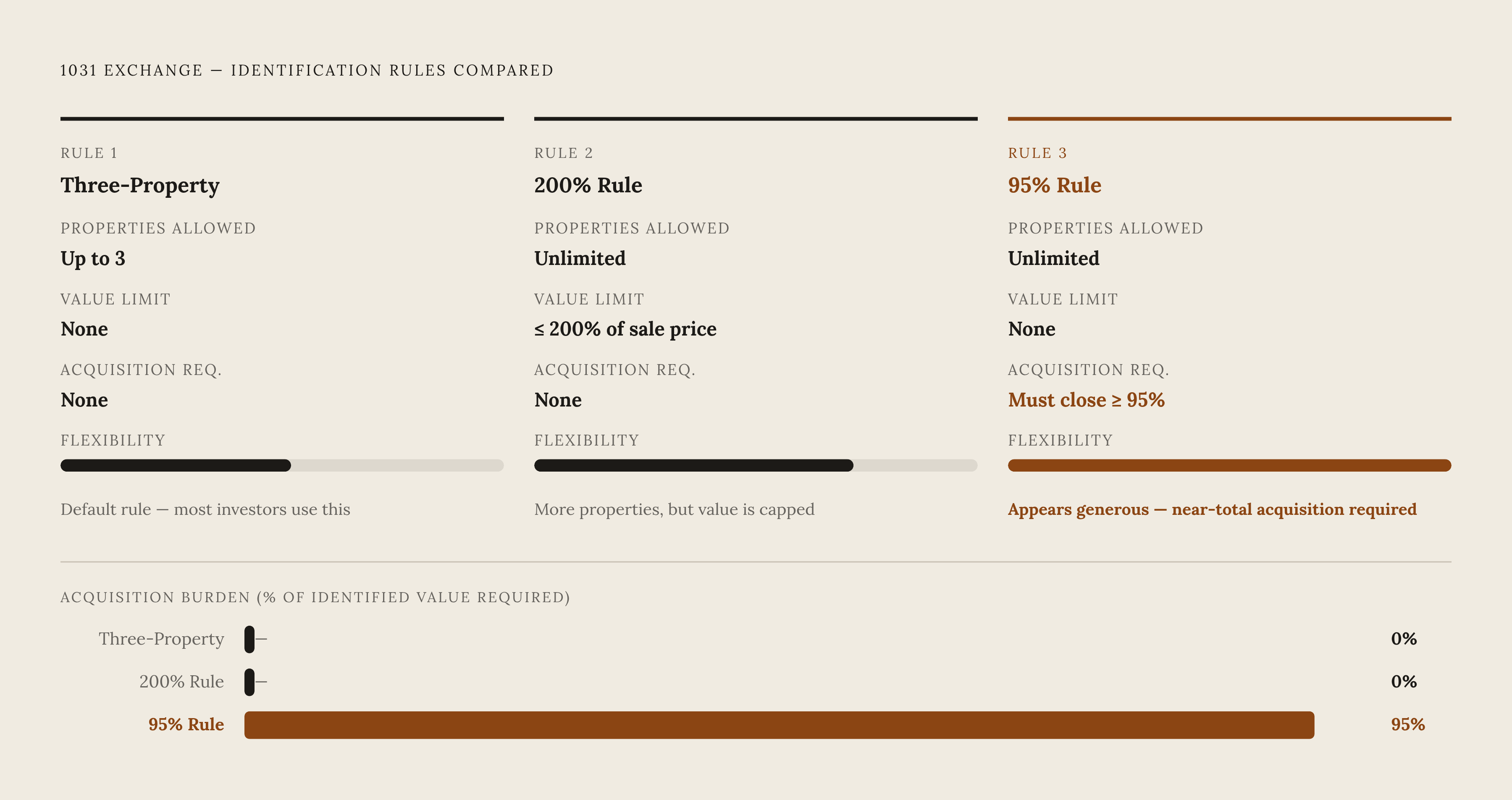
The 95% Rule looks, on paper, like the most generous of the three. It allows an investor to identify any number of properties at any combined value, with no ceiling at all, as long as the investor actually acquires at least 95% of the aggregate fair market value of everything identified.
Run the numbers and the generosity evaporates fast. Identify 20 properties totaling $10 million in combined value, and the rule requires closing on at least $9.5 million of that total, which leaves room for only $500,000 of identified value to go unpurchased. A single failed acquisition in a large pool, one seller who walks, one deal that dies in due diligence, can push the investor below the threshold and take the entire exchange down with it.
This rule has genuine utility for a narrow population: institutional investors or developers who have already pre-negotiated the acquisition of a portfolio and carry high confidence that every piece will close. It was not built as a safety valve for an individual investor running a live, uncertain search for replacement property.
The connection to the 200% Rule matters more than most investors realize. The 95% Rule is the only mechanism that rescues an identification list after it has exceeded the 200% ceiling. But an investor who accidentally busts the 200% limit on a sprawling list is, almost by definition, unlikely to have the ability to close on 95% of that same bloated list before day 180. The 95% Rule exists as a structural feature of the regulations. It is not a comfortable margin of error, and treating it as one is how over-identified lists turn into failed exchanges.
How the three rules interact when a deal falls apart mid-exchange
The identification list freezes the moment day 45 ends. No additions, no substitutions, no deletions, regardless of what happens afterward.
Consider an investor working under the Three-Property Rule who names three candidates. The first-choice deal collapses on day 60, well past the identification deadline. One of the two backups is also off the table by then, perhaps under contract with someone else. That investor is left with exactly one property to close on. There is no room to go find a fourth option, however attractive. The exchange proceeds with that single remaining property or it does not proceed at all.
The 200% Rule handles collapse differently, because it usually leaves more room. Suppose an investor identifies four properties totaling $1.9 million against a $1 million sale, staying under the $2 million ceiling. If one property worth $600,000 falls through, the remaining three still total $1.3 million, comfortably within the 200% limit. The investor can move forward with any of the three that remain, since the list was diversified enough to absorb one loss.
There is also a middle outcome that is not a clean failure: the partial exchange. If an investor closes on some, but not all, of the identified properties, and proceeds are left over that never get reinvested, that leftover cash is treated as boot. Boot is taxable. The exchange itself survives, but the untouched portion of the gain gets recognized as though no deferral applied to it. This is the practical argument for using all three slots under the Three-Property Rule rather than treating backups as optional. They are not padding; they are the only insurance an investor has once day 45 has come and gone.
The most common identification mistakes investors make under deadline pressure
The single most damaging mistake is starting the search too late. Forty-five days feels generous on day one and impossibly tight on day thirty. Investors who close on the relinquished property without a replacement property already in mind routinely burn the first two weeks just getting oriented, and then spend the remaining window under real pressure to sign something, anything, before the list locks.
Vague descriptions cause more failed identifications than most investors expect. Naming a neighborhood or a city, rather than a specific address or legal description, does not satisfy the IRS standard. The description has to remove all ambiguity about which property is meant.
Miscounting and misvaluing show up constantly under the 200% Rule, where investors list several properties without running the combined fair market value calculation first, only to learn after day 45 that the total exceeded the ceiling. A related version of the same error happens under the Three-Property Rule: an investor lists four properties assuming the 200% Rule automatically applies, without confirming the aggregate value actually stays inside the limit.
Over-reliance on the 95% Rule as a general safety net causes damage that is harder to see coming, because it feels responsible in the moment. Treating it as a backstop for a sloppy or oversized identification list, rather than understanding that it demands near-total acquisition success, sets investors up for a collapse they did not see building.
The interaction between the 180-day rule and the tax filing deadline catches fourth-quarter sellers with some regularity. An investor who sells in November or December and does not file for a tax extension may find the 180-day window effectively cut short by the April filing deadline, sometimes by a matter of weeks that matter enormously to a closing timeline.
Two smaller but equally fatal mistakes round out the list. Delivering the written identification to a disqualified party, a relative, an employee, or an agent of the investor, can void the identification entirely, since the document has to reach a non-disqualified recipient, typically the Qualified Intermediary. And assuming a verbal agreement or an unsigned email satisfies the requirement is simply wrong. Only a signed, written document delivered within the 45-day window counts.
The role a Qualified Intermediary plays in the identification process — and what to demand of one
The Qualified Intermediary has to be engaged and the exchange documents signed before the relinquished property closes, not after. There is no retroactive fix here: if the paperwork is not in place before the first sale, the IRS treats the transaction as a taxable sale followed by an unrelated purchase, and the exchange structure never existed as far as the tax code is concerned.
The QI also serves as the standard recipient of the written identification notice. In practice, the investor sends the identification list to the QI, who holds it as part of the exchange file. A competent QI tracks the 45- and 180-day deadlines, checks that the identification list actually satisfies one of the three rules, and flags problems, an over-valued 200% list, a vague property description, before day 45 closes and the mistake becomes permanent.
Here is the part investors underestimate: QIs face no federal licensing requirement, and most states do not regulate them either. Choosing a QI without verified experience and real financial safeguards puts the entire exchange, and the full deferred gain, at risk on the basis of trust alone. The 2008 case of a major title company subsidiary that filed for bankruptcy while holding more than $450 million in exchange proceeds illustrates exactly what that risk looks like. More than 450 investors were affected. Fifty of them had specifically requested segregated accounts and were protected. The rest had funds sitting in commingled accounts that got pulled into the bankruptcy proceedings alongside everyone else's.
Investors evaluating a QI should ask for specifics, not reassurances. Funds need to sit in segregated accounts held separately per exchanger, not pooled with other clients' money. The QI should carry a fidelity bond and Errors and Omissions insurance. FDIC coverage protects up to $250,000 per account holder under standard rules, and anything above that threshold needs additional structuring; some QIs now set up accounts specifically to carry meaningfully higher coverage than the standard limit. Funds should also sit in a conservative investment posture, available on short notice for the replacement purchase, not locked into instruments that could lose value or take time to liquidate.
On the compliance side, ask about background in real estate or law, and about the QI's actual process for reviewing an identification list before day 45, not simply logging it after the fact. And ask directly about fees and interest. Traditional QI fees for a standard exchange run from several hundred dollars to well over a thousand, and many QIs keep the interest earned on held funds for the duration of the exchange as part of their compensation. Some QIs share that interest back with the client instead. Deferred.com, a no-fee 1031 Qualified Intermediary that charges nothing for the exchange and passes the interest earned on held funds directly to the investor, is one concrete example of that model. On a larger exchange held for several months, that difference is not trivial, and it is a fair question to ask before signing anything.