Qualified Intermediary Regulations by State
Only eight states require qualified intermediaries to carry insurance and bonds.
A tax-code provision governing exchange proceeds has roots going back to 1921, yet the statute itself is nearly silent on who should be trusted to hold your exchange proceeds. That silence is the entire problem this piece is about. The federal government sets the tax rules; the states, unevenly and in some cases not at all, set the safeguards around the person holding your money while those rules play out.
The IRS requirement for a Qualified Intermediary is narrow by design. A QI has to be independent: the "disqualified person" rule bars anyone who has served as the taxpayer's attorney, CPA, real estate broker, or employee within the two years prior to the exchange. That single question about segregation is among the most consequential an investor can ask, because commingled accounts are the mechanism behind nearly every historical QI collapse. No federal licensing exam, no bonding requirement, no minimum capitalization, no insurance mandate, and no ongoing examination of how a QI actually runs its operation. A QI holds the exchange funds, drafts the exchange agreement, and prepares the assignments and notices that make the transaction valid under Section 1031. It is a role carrying enormous fiduciary weight, attached to almost no credentialing bar.
What QI failures look like, and why they prompted states to act
The gap between fiduciary responsibility and regulatory oversight isn't theoretical. The Federal Trade Commission reported in 2012 awareness of 23 instances in which investors lost an estimated $250 million due to QI fraud and negligence. That figure is what actually moved state legislatures, not some abstract concern about industry best practices.
The mechanism behind most of these failures is almost boringly simple. A QI holds client funds in a non-segregated account, mixes that money with its own operating capital, and at some point either becomes insolvent or simply disappears with what's left. When that happens, the investor has no federal safety net to fall back on. Exchange funds sitting with a QI carry no FDIC protection by default, unlike a checking account or a CD. The investor's entire equity in the exchange, sometimes the accumulated gain of decades of property ownership, rests entirely on the QI's solvency and, frankly, on its honesty. There's no insurance fund standing behind that trust.
The states that regulate QIs and what their rules require
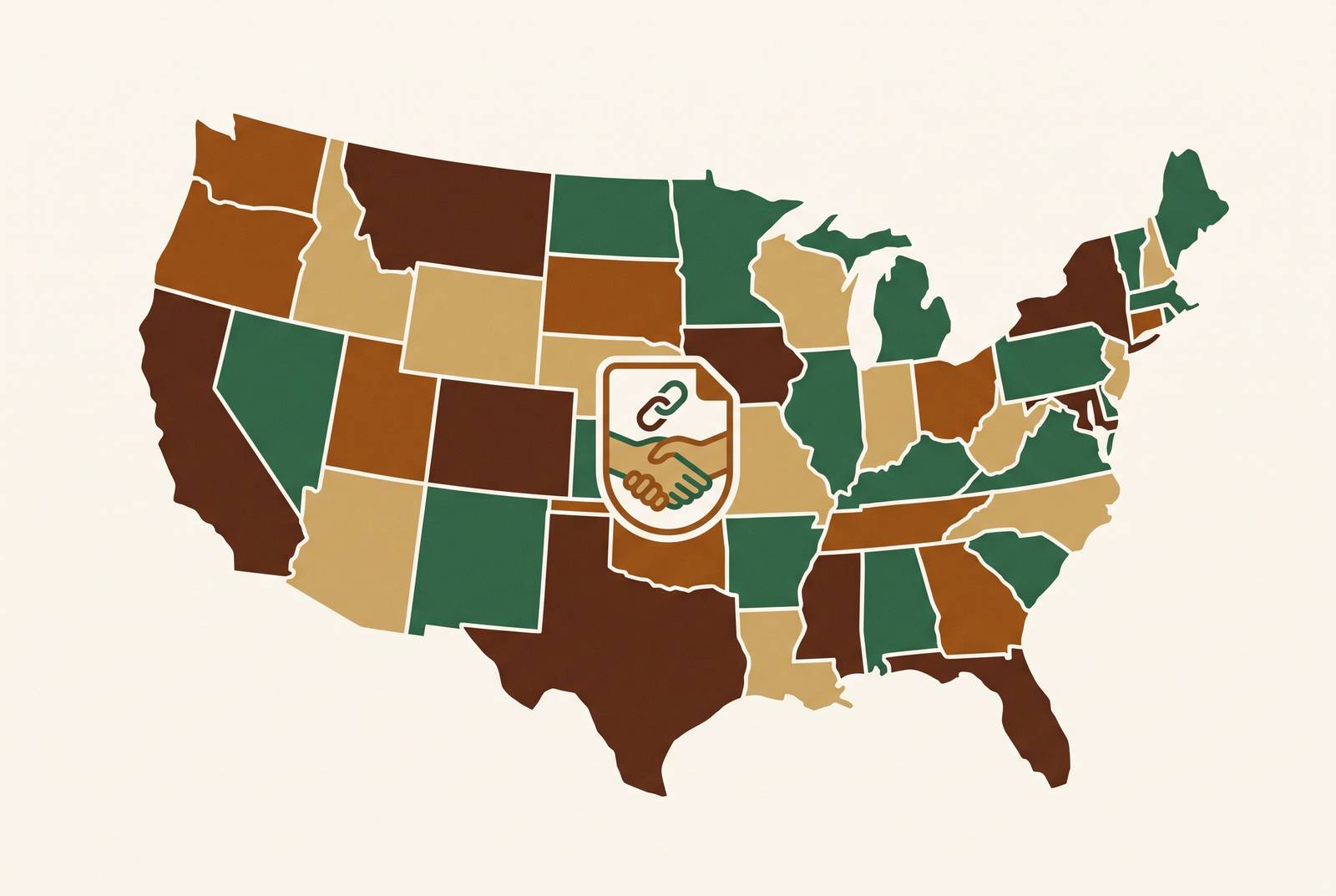
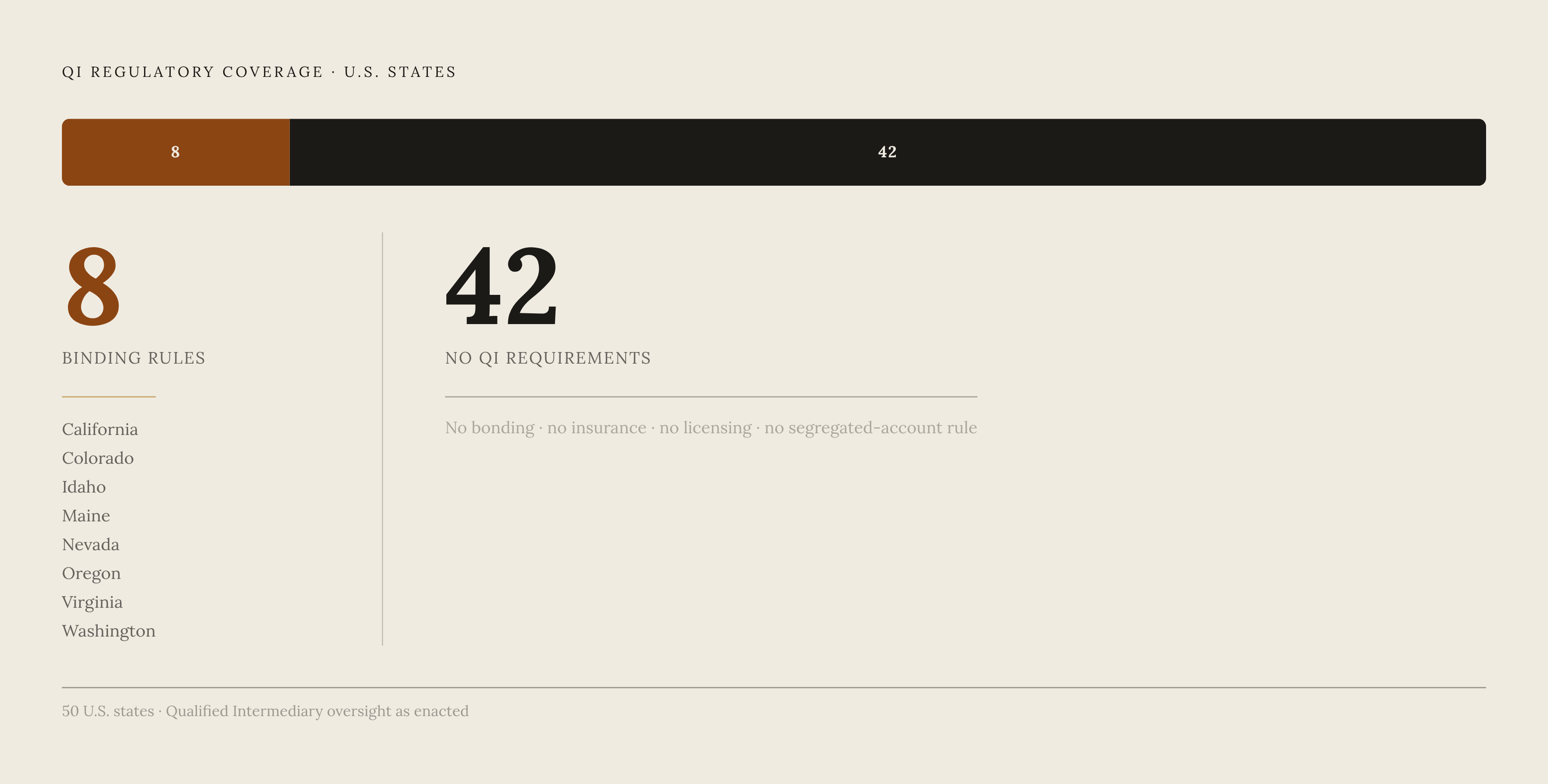
Given the scale of those losses, it's worth asking how many states actually responded with binding rules. Eight states responded: California, Colorado, Idaho, Maine, Nevada, Oregon, Virginia, and Washington. That's it out of fifty.
California built the most detailed model in the country, and walking through it shows what real oversight looks like in practice. A California QI must carry at least $250,000 in errors and omissions insurance and maintain a fidelity bond of no less than $1,000,000. QIs operating in the state are also held to a prudent investor standard when managing client funds, and violations expose them to civil liability under California law, giving a wronged investor a basis for legal recourse rather than a complaint filed into the void. The state also updated its withholding rule effective January 1, 2022, limiting a QI's withholding obligation to available funds in cases where the QI never received sufficient funds from escrow or already disbursed funds to complete a Section 1031 exchange. Given that California taxes all capital gains as ordinary income at a rate of 13.3%, with no preferential long-term rate at all, the cost of a failed exchange in that state is uniquely punishing. A blown exchange in California doesn't just cost you the deferral; it drops you into one of the steepest capital gains regimes in the country.
Nevada, Colorado, Washington, and Idaho have each enacted or proposed legislation governing QIs, though the specific bond and insurance thresholds in those states aren't uniform or fully documented the way California's are. Maine and Oregon round out the list of regulated states. In each of these, the direction is the same even where the specifics vary: lawmakers decided that an unregulated fiduciary holding six or seven figures of client money for months at a time was an unacceptable gap.
Doing a 1031 exchange in an unregulated state
Eight states out of fifty means the overwhelming majority of the country imposes no QI-specific requirements whatsoever. No bonding, no insurance mandate, no licensing, no rule requiring segregated accounts.
In those states, virtually anyone can set up shop as a Qualified Intermediary. No credential is required, no proof of financial backing, no regulatory body examining the books. The investor's only protection is whatever due diligence they perform themselves, plus whatever voluntary practices the QI has chosen to adopt on its own. Nothing compels good behavior beyond the QI's own reputation and internal policy.
This isn't a marginal issue affecting a handful of small transactions. The top ten QIs in the country handle roughly 65% of all exchanges by dollar volume. Over a third of exchange volume flows through a long tail of smaller firms, many of them operating in the states with the least oversight. Scale doesn't eliminate the risk; it concentrates the risk among the long tail of smaller firms operating with the least oversight.
Evaluating a QI's fund security when your state's law doesn't require it
Two factors matter more than anything else when choosing a QI: how safely the funds are held, and how competent the staff actually is. The regulatory gap described above means the first of those can't be assumed. It has to be verified, directly, before signing anything.
Start with segregation. Ask whether the QI holds exchange funds in a separate, dedicated account for each individual client, rather than pooling client money together or mixing it with the firm's own operating funds. Commingled accounts are the mechanism behind nearly every historical QI collapse, so this single question does more to protect an investor than almost anything else on the list.
Bonding and insurance come next. Even in a state with no legal requirement, ask whether the QI carries a fidelity bond and errors and omissions coverage, and ask for the actual dollar amounts. California's mandated floor, $1,000,000 in fidelity bonding and $250,000 in E&O insurance, is a reasonable benchmark to measure any QI against, regardless of where the exchange is taking place.
Then there's disbursement control, which gets less attention than it deserves. Look for dual-authorization requirements on any release of funds, meaning more than one person must approve a disbursement before it can proceed. That kind of structural friction is precisely what stops a single bad actor from moving client money out the door unnoticed.
The interest earned on held funds, the protection question most investors never ask
Exchange funds can sit with a QI for up to 180 days. On a sizable transaction, that's not a trivial stretch of time, it's months during which real money sits somewhere earning a return for somebody.
Industry observers have noted that a QI's revenue can skew more heavily toward interest earned on client funds than toward the fees charged upfront, meaning the float may represent a significant share of total income rather than stated service fees. On a large exchange, the interest retained by the intermediary over the full 180-day hold period can be substantial, and under traditional fee structures, that interest is typically kept entirely by the QI rather than passed back to the client. Compare that against the fee itself: standard forward exchange fees run somewhere in the $750 to $1,500 range, while reverse and improvement exchanges run considerably higher, from $3,000 up to $15,000 or more. The stated fee is the visible cost. The float is the real economic question, and it's the one most investors never think to ask about before signing.
What to look for in a QI regardless of your state's regulatory approach
State regulation sets a floor, not a ceiling. A California QI meeting the state's $1,000,000 fidelity bond requirement can still, technically, commingle client funds where the law allows, keep the entirety of the interest earned, and hand off the file to a junior staffer the moment the first call ends. Meeting the legal minimum and actually protecting the client's interests are two different things, and conflating them is where a lot of investors go wrong.
A QI should be held to a standard that goes beyond compliance. Look for dedicated senior Exchange Officers handling the file, not commissioned salespeople whose incentive is closing the deal rather than managing the exchange correctly. Continuity matters too: the same person should be reachable from the first phone call through final closing, without the file getting passed around a rotating cast of staff mid-transaction.
Transparency is where the real signal appears. A QI that publishes its interest rates openly, rather than negotiating them case by case behind closed doors, is telling clients something important about how it operates. Real-time portal access, available not just to the investor but to their broker, attorney, and CPA, keeps every party aligned as the clock runs down. A clear, written fee schedule delivered before anyone signs the exchange agreement removes ambiguity that would otherwise surface at the worst possible moment.
Speed matters operationally in a way that's easy to underestimate until it's the deadline in question. The 45-day identification window and the 180-day closing deadline built into Section 1031 leave no room for delay, so a QI capable of opening an exchange the same day, even at the closing table itself, is structurally better equipped to protect an investor's timeline than one that requires advance notice or operates on a restricted schedule, Deferred.com, a no-fee 1031 Qualified Intermediary that holds client funds in segregated FDIC-insured accounts and shares interest back with the investor, is one example of that kind of operation, able to open an exchange in as little as five minutes with support available seven days a week until midnight. When the deadline is fixed by statute and the stakes are the entire tax deferral, availability is part of the protection. It's part of the protection.
Sources
- 1031 Exchange: The Complete 2026 Investor Guide
- ctacquisitions.com
- Is Your 1031 Money Safe? Know Your Qualified Intermediary Risks.
- Failure of IRC §1031 Exchange Qualified Intermediary Highlights Risks and Is a Reminder of the Importance of Due Diligence When Selecting a Qualified Intermediary - Foster Garvey
- 1031 Exchange Fraud & Qualified Intermediary Safety
- ftb.ca.gov