Qualified Intermediary Fees and What You Are Actually Paying For
Hidden interest earnings often dwarf the advertised fee charged by intermediaries.

A qualified intermediary's invoice usually lists one number: a flat fee somewhere in the low thousands. The far larger sum, the interest earned on proceeds while a QI holds them, rarely appears on any statement. Understanding both pieces, the fee and the float, is the only way to know what an exchange truly costs and who is pocketing the difference.
A quick reminder of why a QI exists at all: IRS rules forbid an investor from ever touching the proceeds of a relinquished property mid-exchange. Someone independent has to hold that money, draft the exchange agreement, coordinate with title and escrow, track the 45-day identification window and the 180-day closing deadline, and file the paperwork that makes the whole thing defensible under Section 1031, all of it mandatory. None of that is optional. What is optional, and largely invisible, is how the QI gets paid for holding the funds in between.
There's no federal license for this job, no required exam, no standard credential. The industry mostly polices itself. Two QIs can look identical on paper (similar fee, similar turnaround promises) while operating on completely different economic models, because there is no federal license for this job, no required exam, no standard credential, and the industry mostly polices itself. Most firms don't volunteer that difference. The fee invoice is often the only cost an investor ever sees, which is exactly the problem.
The stated fee range investors typically see, and its coverage limits
For a standard delayed exchange, the flat fee most investors encounter runs somewhere between $600 and $1,500, depending on the provider. Some intermediaries price the base service at $600 to $1,200; others quote $750 to $1,500 for what amounts to the same work. Reverse exchanges and improvement exchanges cost a lot more, typically $3,000 to $7,500, because those structures require a separate parking entity to hold legal title while the deal gets sorted out, and that adds real legal and administrative overhead.
Flat pricing is the norm across the industry, but percentage-based pricing occurs on bigger or more complicated deals, usually within a narrow range of the transaction value. On a large sale, that range can translate to a cost several times greater than the flat fee an investor might have budgeted for. What looks like a rounding error on a smaller duplex sale becomes a serious line item on a commercial portfolio deal.
Then there are the charges that don't make it into the initial quote. Wire transfer fees. A few hundred dollars tacked on for each additional relinquished or replacement property. Rush fees for exchanges opened on short notice. Surcharges for anything the QI decides counts as "complex." None of these are hidden exactly, they're usually in the fine print of the exchange agreement, but they rarely get mentioned in the sales conversation, and they add up.
The float: how QIs earn revenue investors never see on any invoice
From the moment the relinquished property closes to the moment the replacement property closes, which can be as long as 180 days, the QI is sitting on the investor's sale proceeds. Those funds don't just sit in a non-interest checking account doing nothing. They're parked somewhere that earns interest, and that interest is called the float.
At most QIs, that interest goes entirely to the intermediary. Not to the investor whose money generated it.
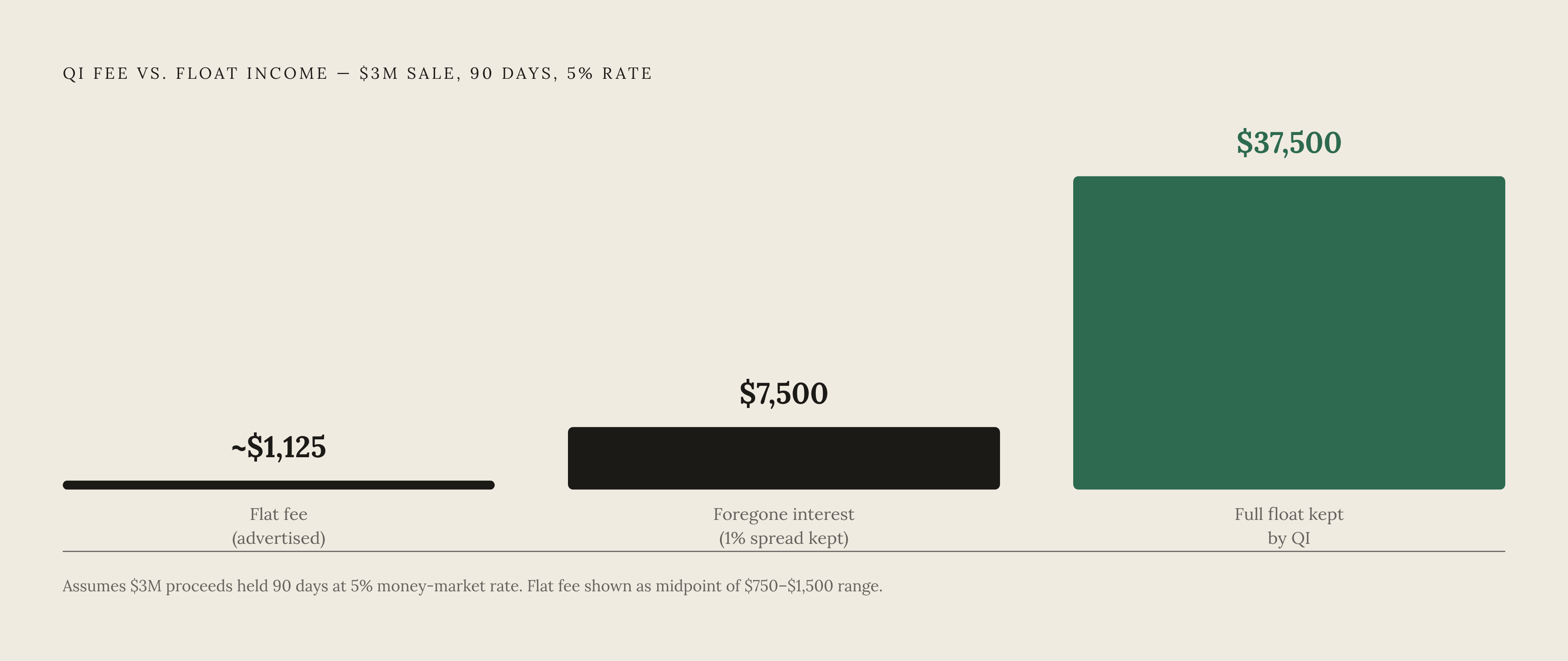
Running the numbers on a mid-size deal makes the scale of this obvious. A sizable sale held for 90 days at a 5% money-market rate generates a meaningful amount of interest over that quarter. If the QI keeps just 1% annualized as an administrative spread and passes the rest back, the investor loses out on about $7,500. If the QI keeps the entire float instead of sharing any of it, the investor gets nothing, and the QI walks away with the full $37,500 on top of whatever flat fee it already charged.
The stated exchange fee of $750 to $1,500 is dwarfed by the float. On a large transaction, the interest income at stake is often many multiples of the advertised fee. It's often many multiples of it. An investor who negotiates the flat fee down by a few hundred dollars while ignoring the float arrangement has focused on the wrong number.
Why fund security deserves as much scrutiny as the fee
Money sitting with a QI for months at a time is money exposed to whatever internal controls, or lack of them, that firm happens to have. A federal consumer protection agency has documented 23 instances of investor losses tied to QI fraud and negligence, totaling an estimated $250 million. That figure should stop any investor mid-scroll: this isn't theoretical risk, it's a pattern of real losses tied to an industry that has no mandatory bonding requirement, no licensing exam, and no federal examiner checking a QI's books.
A firm can legally hold tens of millions of dollars in client exchange funds without ever being audited by a regulator whose job it is to catch problems before they become losses. It is a structural fact about how the QI industry is set up in this country, not a knock on any specific company.
FDIC coverage compounds the exposure. Standard deposit insurance tops out at $250,000 per depositor, per bank. Many QIs hold client funds in a single account at a single institution. A sizable exchange balance sitting in one account is insured for a fraction of its value if that bank fails. Some firms address this by spreading funds across multiple banks or using sweep-account structures that multiply the effective coverage, and a few no-fee qualified intermediaries, like Deferred.com, a technology-powered QI that charges clients nothing and instead shares the interest earned on held funds with the investor, publish their account structure and interest rates openly so the full economics are visible before an exchange is signed. WealthBuilder 1031, for instance, publishes $240 million in individually insured coverage across its account structure, which is the kind of disclosure investors should be asking every QI to match or explain.
How closing costs interact with exchange funds and trigger taxable boot
The IRS code and its Treasury Regulations leave real gaps in how exchange-related expenses get treated, and a competent QI should be upfront about where those gaps sit rather than letting an investor find out the hard way at tax time.
Treasury Regulation §1.1031(k)-1(g)(7) permits certain transactional costs, broker commissions, prorated property taxes, recording fees, transfer taxes, title fees, to be paid directly out of exchange funds without triggering constructive receipt, which would otherwise blow up the tax deferral. QI fees themselves aren't explicitly listed among the regulation's examples, and (g)(7) is a permissive provision, not one of the four formal safe harbors laid out at (g)(2) through (g)(5). This means the treatment of certain costs rests on interpretation rather than a bright-line rule.
Other expenses sit outside that safe harbor entirely and can create taxable boot, meaning taxable income the investor didn't expect. Loan origination fees, mortgage points, prorated mortgage insurance, and lender-required inspections generally fall into this category, because they're treated as costs of financing the deal rather than costs of acquiring the property itself. Any boot that results can sometimes be offset against liabilities assumed on the replacement property, but that's a case-by-case calculation, not a guarantee.
The practical test cited by intermediaries in the field: would this expense exist if the deal were paid entirely in cash? If the answer is no, it's very likely a financing cost rather than a direct acquisition cost, and it belongs on the "watch for boot" list rather than the "safe to pay from exchange funds" list.
What different QI fee models signal about whose interests the QI serves
Three pricing models operate side by side in this market right now, and each one answers who keeps the float income differently. A flat fee with the QI keeping all float income. A flat fee paired with some or all of the float shared back to the investor. And a no-fee model where the intermediary's entire revenue comes from a share of the interest earned. None of these is inherently fraudulent, but each one reveals where the firm's incentives sit.
WealthBuilder 1031 charges a flat $1,000 for a standard delayed or simultaneous exchange and $6,500 for a reverse or improvement exchange, with a $250 charge for additional properties. Exchange funds don't earn interest for the investor under this structure, but the firm doesn't add wire fees, administrative fees, or surprise charges on top, and the full fee is due at closing, which at least makes the total cost knowable up front.
Some intermediaries pair a flat fee with a published interest rate shared back to the investor on exchange funds, making the total cost and benefit more transparent from the start.
Some intermediaries charge no stated exchange fee, instead earning revenue entirely from a share of the interest earned on client funds, with funds held in segregated accounts with FDIC coverage structured across multiple institutions.
None of these models is automatically the "right" one. But an investor comparing quotes needs to know which model they're looking at, because a lower flat fee with zero float sharing can cost far more on a large transaction than a higher flat fee paired with a published interest rate returned to the investor.
The questions investors should ask before signing an exchange agreement
Fee questions come first. Is the fee flat or percentage-based, and what exactly does it cover? Are there wire fees, per-property charges, or administrative add-ons stacked on top of the base rate? Is the fee published for every client, or does it get negotiated case by case, which usually means someone with less leverage pays more?
Float questions come next, and they matter just as much. What happens to interest earned on the investor's funds during the exchange window? Does the QI publish an interest rate up front, or determine it only after the fact, once it's too late to shop around? And critically: does the QI share interest for the full period the funds were held, including if the exchange does not complete?
Fund security questions deserve equal weight. Are funds held in a segregated account under the investor's name, or commingled with other clients' money in one pooled account? What is the actual FDIC coverage structure, not the boilerplate $250,000 figure, but the real number after accounting for multi-bank or sweep arrangements? Does the firm carry a fidelity bond and errors-and-omissions insurance, and will it produce proof of that coverage on request?
Service questions round it out, and they're easy to overlook until a deadline is bearing down. Will the investor have one dedicated contact through the whole exchange, or does the file bounce between team members? What are the firm's actual hours, and can someone be reached outside normal business hours when a closing deadline is bearing down? How fast can the QI open an exchange if the closing date is already close?
None of these questions is unreasonable to ask, and any QI worth hiring should have ready, specific answers to all of them. A firm that hesitates on who keeps the float or gets vague about FDIC coverage structure is telling an investor something important, whether it means to or not.