Primary Residence Exclusion vs. 1031 Exchange Rules
Misclassifying personal-use property can disqualify an entire 1031 exchange before it starts.

Every 1031 exchange starts with one question: was the property held for productive use in a trade or business, or for investment? Get a "no" on that question, and the exchange never gets off the ground. Personal use disqualifies a property at the threshold, no matter how the sale is later structured.
Section 121 runs the opposite test. The property has to be the taxpayer's primary residence. Investment or business use knocks out the full exclusion, though a partial exclusion can survive mixed use, as later sections cover.
That leaves a category of property that qualifies for neither tool, and this is the gap most investors don't see coming. A vacation home used personally every summer but never rented doesn't satisfy 1031's investment-use requirement, and it isn't a primary residence either, so it gets no help from 121. The same is true of fix-and-flip inventory held for resale, and it's true of second homes generally. A common misread of the rules assumes that calling a property an "investment" on paper unlocks 1031 treatment. It doesn't. The IRS doesn't care what the owner calls it on a spreadsheet if the owner uses it personally and has never leased it.
One more threshold rule trips up otherwise careful investors: the taxpayer identity must remain consistent throughout a 1031 exchange. Whoever sells the relinquished property, individual or entity, has to be the one who acquires the replacement property. A change in taxpayer identity mid-exchange, even for a reasonable business reason, can unravel the exchange.
Get the use classification wrong at this stage, and nothing downstream matters. Planning has to start here, not end here. Treating this as a formality is the single most common error in this entire area of the code, and it's an unforced one: the fix is simply asking the question early enough to still change the answer.
How Section 121's ownership-and-use clock works
Section 121 asks whether the taxpayer owned and used the property as a primary residence for at least 24 months out of the 60 months before the sale. Those 24 months don't need to run consecutively. An owner who lived in a home for 14 months, moved out, came back for another 10, and sold within the five-year window still clears the bar.
The dollar caps are fixed: $250,000 of excluded gain for a single filer, $500,000 for a married couple filing jointly. The exclusion can only be claimed once every two years, so an owner who sells one primary residence and buys another can't stack the benefit repeatedly within a short span.
What the exclusion doesn't touch is depreciation recapture. If the property was ever rented and the owner claimed depreciation deductions against rental income, that portion of gain stays taxable even after the 121 exclusion wipes out the rest. The exclusion forgives capital gain. It doesn't forgive depreciation already deducted, and conflating the two is a mistake that costs real money at closing.
There's no reinvestment requirement attached to any of this. An owner can sell, exclude the gain, and spend the proceeds on anything, including nothing related to real estate at all. That's the defining difference from 1031: 121 permanently writes off gain up to the cap, rather than deferring it on the condition that the owner buys something else.
Life doesn't always cooperate with a clean 24-month test. A job relocation, a health emergency, or another unforeseen circumstance can cut the occupancy period short, and in those cases a prorated exclusion may still be available. The math varies by circumstance, but falling short of 24 months isn't automatically fatal.
How Section 1031's timing rules create a different kind of discipline
Section 121 asks the owner to wait and then sell. Section 1031 asks the investor to move fast, on a clock that starts the day the relinquished property closes and doesn't stop for anyone.
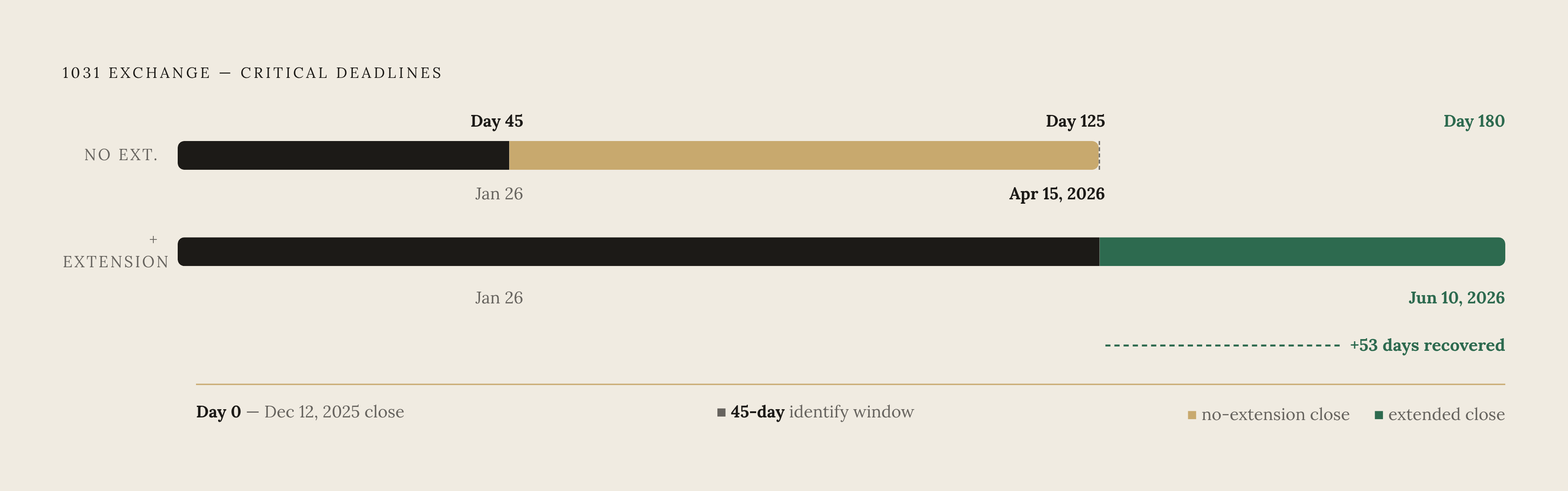
Two deadlines govern every exchange. The investor has 45 calendar days to identify replacement property in writing, and 180 calendar days to close on it, or the due date of that year's tax return, whichever comes first. That "earlier of" clause is the deadline most exchanges trip over, and it's the one investors seem least prepared for. For any relinquished property sale closing on or after October 17, 2025, the effective deadline to close on replacement property lands on April 15, 2026, well short of the full 180 days, unless the investor files a tax return extension. File the extension, and the full 180-day window comes back. On a sale closing December 12, 2025, that extension recovers the window out to June 10, 2026, a difference of 53 calendar days of replacement time.
Neither deadline bends for a weekend or a holiday. They're strict calendar counts, and the only thing that moves them is a federally declared disaster with an IRS postponement attached. The Los Angeles County wildfires in 2025 produced exactly that kind of relief: affected 45-day and 180-day deadlines were extended to the later of October 15, 2025, or 120 days past the original deadline.
Identifying replacement property isn't a free-for-all, either. Investors work within one of three rules. The Three-Property Rule allows identifying up to three properties regardless of value. The 200% Rule allows identifying more than three properties, as long as their combined fair market value doesn't exceed 200% of what the relinquished property sold for. A third rule permits identifying an unlimited number of properties under stricter conditions, though in practice it sees little use given how hard it is to satisfy.
An exchange that starts mid-year and stretches into the following year still gets reported entirely on the first year's tax return. There's no equivalent filing choreography under Section 121: a homeowner sells, claims the exclusion, and the transaction is closed. That deadline discipline, demanded by 1031 and never asked for by 121, is the sharpest structural difference between the two provisions. It's also the one that catches investors who assume the two tools run on the same clock.
What "like-kind" and "equal or greater value" mean in practice for 1031
"Like-kind" sounds narrow, but in real estate it's about as broad a standard as the tax code offers. A single-family rental can exchange for a commercial building. Raw land can exchange for an apartment complex. As long as both properties sit on the investment or business side of the ownership line, they're like-kind to each other.
That breadth used to extend further. Before 2018, personal property, equipment, vehicles, and other non-real-estate assets could qualify for exchange treatment. The 2017 tax reform law eliminated all of that, leaving real property as the only asset class 1031 still covers, and investors who still think their equipment or franchise rights qualify are working off rules that expired years ago.
Full deferral requires replacing both the equity and the debt tied up in the relinquished property. The replacement property has to be of equal or greater value, and any mortgage debt paid off at closing needs to be replaced with equal or greater debt on the new property, or offset with additional cash. Fall short on either front, and the shortfall becomes "boot," meaning cash received or debt relief not replaced. Boot gets taxed immediately in the year of the exchange, even though the rest of the transaction defers cleanly.
Depreciation recapture doesn't vanish in an exchange. It travels forward, embedded in the replacement property's basis, and surfaces again whenever that property is eventually sold outside another exchange. That's a meaningful contrast with Section 121, where gain is forgiven outright up to the cap. Under 1031, nothing is forgiven. Everything is postponed, and investors who forget that distinction tend to overestimate how clean their eventual exit will be.
Investors sitting on gain recognized through boot should also account for the 3.8% Net Investment Income Tax, which can apply to that recognized portion depending on income level. Model it before the deal is structured.
One narrow carve-out matters: incidental property, meaning items whose value comes to less than 15% of the total replacement property value, doesn't need to be separately identified on the 45-day notice. It's a small provision, but it saves paperwork on deals involving furnished rentals or properties with minor equipment attached.
Converting a property from one use to another, and why timing determines which tool applies
Converting a rental into a primary residence is straightforward on paper: the investor moves in and lives there for at least 24 months. Once that clock runs out, the 121 exclusion becomes available on up to $250,000 or $500,000 of gain, depending on filing status.
Running the conversion in the other direction takes more care, and this is where investors most often overestimate how fast they can move. An investor who moves out of a primary residence and starts renting it needs the property to function as a rental for at least 12 to 18 months before it reliably qualifies for 1031 treatment. Meanwhile, to preserve any 121 exclusion later, the owner still needs to satisfy the two-of-five-year occupancy test measured from the eventual sale date.
The five-year lookback window is what makes it possible to qualify for both provisions on the same property. If the 24-month occupancy period and the rental seasoning period both fall within that five-year span, an owner can walk away with both a 121 exclusion and 1031 eligibility on the same transaction.
None of this erases depreciation. Any depreciation claimed while the property operated as a rental stays subject to recapture, regardless of how the property was later used or classified. And the IRS doesn't take an owner's word for it: converting a property means documenting it, with lease agreements, rental income reported on Schedule E, and property management records. An undocumented claim of "intent to rent" doesn't satisfy the investment-use test for 1031, no matter how sincere the intent was, and this is where a surprising number of otherwise sophisticated investors get tripped up.
Conversion strategies work, but they take years of forward planning, not a few months of paperwork before closing. That timeline is exactly what makes the hybrid strategy below possible.
Combining Section 121 and Section 1031 on a single property
The combination becomes relevant when a property has served both as a primary residence and as an investment over its ownership history, and the total gain exceeds what Section 121 alone can absorb. In that situation, the 121 exclusion soaks up the first layer of gain, and 1031 deferral picks up whatever remains above the cap.
Order matters here. The 121 exclusion applies first, up to $250,000 or $500,000 depending on filing status. Whatever gain is left over becomes eligible for 1031 deferral, provided the exchange satisfies every other requirement covered above.
On a mixed-use property, the exclusion applies as a partial benefit rather than an all-or-nothing one. It's proportional. Consider an owner who held a property for ten years, rented it out for eight of those years, and then lived in it for the final two before selling. The excludable share of gain is proportional, so the eight rental years reduce, rather than eliminate, the exclusion.
Three scenarios illustrate how this plays out. In the first, an investor converts a rental into a primary residence, occupies it for at least 24 months, and then sells, claiming the 121 exclusion against the gain attributable to the residential period. In the second, an owner moves out of a primary residence, rents it for 12 to 18 months while still satisfying the two-of-five-year test, and sells, claiming the 121 exclusion on qualifying gain and 1031 deferral on the excess. In the third, a property with genuine mixed use throughout its ownership is sold directly, with gain split according to the ratio of residential to rental time, and each portion routed to the tool that fits it.
Depreciation recapture is the one thing this combination can't touch. It isn't excludable under 121, and 1031 doesn't forgive it either. It remains embedded in the deferred gain and surfaces again when the replacement property is eventually sold in a taxable transaction. Pulling off this kind of layered transaction takes years of advance coordination among a tax advisor, a real estate attorney, and a qualified intermediary. It isn't something an owner backs into a week before closing, and treating it that way is how these strategies collapse under audit.
Where each strategy leaves the investor at the end of the transaction
After a Section 121 exclusion, gain up to the cap is gone from taxable income permanently. There's no future liability lurking, no replacement property obligation, and no restriction on what the owner does with the proceeds. The one thing that survives the exclusion is depreciation recapture tied to any rental period, which stays taxable regardless.
A 1031 exchange leaves a different picture. The gain isn't forgiven; it's deferred, and the replacement property inherits a carryover basis equal to the relinquished property's adjusted basis. That deferred gain, along with any accumulated depreciation recapture, sits dormant until the replacement property is eventually sold in a taxable transaction.
Serial exchanges are where 1031's logic compounds, and this is where the provision earns its reputation among long-term investors. An investor can repeat the exchange process indefinitely, rolling deferred gain from property to property, letting the full pre-tax equity keep working rather than shrinking with each sale. If the investor holds the final property until death, heirs may receive a stepped-up basis under applicable tax rules, which can reduce or eliminate the deferred gain rather than merely postponing it further. That's the real payoff of 1031, and it has nothing to do with any single exchange. It's about never triggering the tax at all.
Section 121 scales differently, and it scales worse, full stop. It's capped, limited to once every two years, and it doesn't grow alongside a portfolio the way a chain of 1031 exchanges does. A homeowner with gain under the cap and no interest in buying another property gets the most out of 121. An investor sitting on large accumulated gains with a clear reinvestment target gets far more out of 1031, and should stop treating 121 as the stronger tool just because it forgives instead of defers. Exclusion that caps out at $500,000 isn't more powerful than deferral with no ceiling at all. A long-term owner with a mixed-use history and gain well above the cap is exactly the profile the hybrid strategy was built for.
Mistakes that disqualify investors from the tool they intended to use
Section 121 claims fail for reasons that sound small but aren't. Missing the 24-month occupancy threshold by even a single day, absent a qualifying hardship exception, forfeits the exclusion. Claiming the exclusion twice within a two-year window doesn't work either. And assuming that depreciation taken during a rental period gets excluded along with everything else is simply wrong. It doesn't.
Section 1031 punishes a longer list of errors, and most of them are procedural rather than conceptual, which is exactly why they're preventable and exactly why investors keep making them anyway. Touching the sale proceeds, even briefly, disqualifies the exchange: the qualified intermediary has to hold the funds from the moment the relinquished property closes until the replacement property is acquired, with the investor never taking constructive receipt. Missing the 45-day identification deadline collapses the exchange outright, and no extension exists for it apart from a formally declared disaster. A reverse exchange requires careful advance structuring before any property closes, not retrofitted afterward. Selling late in the year without filing a tax return extension shortens the 180-day window down to the April 15 deadline, a difference that can cost an investor 53 days or more of time to find and close on replacement property. Identifying replacement property with a vague description, rather than a legal description, street address, or otherwise distinguishable name, invalidates the identification notice. And assuming a vacation home qualifies simply because the owner calls it an investment doesn't hold up if the property has never been leased and continues to serve personal use.
The hybrid strategy carries its own failure points. Treating a conversion as a paperwork exercise, rather than an actual change in how the property is used, invites scrutiny. Failing to document rental income, lease terms, and occupancy dates leaves nothing to support the claim if it's challenged. And underestimating how many years of prior rental use will proportionally shrink the 121 exclusion leads investors to expect a bigger tax break than the numbers actually deliver.
Nearly every mistake on this list traces back to the same root: misreading a use test, a deadline, or an ownership requirement, exactly the distinctions the earlier sections spelled out. None of these are edge cases. They're the predictable, recurring failures that show up whenever someone treats 121 and 1031 as roughly the same kind of tax break.
What the qualified intermediary does in a 1031 exchange and why QI selection matters
A qualified intermediary exists because of one structural requirement: the investor can never touch the sale proceeds between closing on the relinquished property and acquiring the replacement. The QI is the entity that takes custody of those funds, holds them in escrow, and disburses them to fund the replacement purchase. Without a QI standing between the two closings, the IRS treats the transaction as a straight sale followed by a separate, unrelated purchase, and the exchange fails on constructive receipt grounds before any deadline or identification rule even comes into play.
That custodial role makes the choice of intermediary more than an administrative detail. Picking whoever charges the lowest fee, without looking past the fee schedule, is a mistake with real financial stakes attached to it. The QI holds the investor's entire sale proceeds for up to 180 days, sometimes longer if a tax return extension pushes the window out further. During that period, the funds are held by the qualified intermediary, and the terms of that account, how the funds are held, what happens if a dispute arises over the exchange documents, how quickly the QI can move on a tight closing timeline, matter as much as the exchange mechanics themselves.
The QI also drafts and manages the exchange agreement, ensures the written identification notice is delivered within the 45-day window, and coordinates the paperwork trail that supports the eventual tax reporting. Investors juggling a Three-Property Rule identification against a hard 180-day close, especially one complicated by the October 2025 deadline compression discussed earlier, depend on the QI to keep every document properly timestamped and every disbursement properly documented. A missed signature or a late-filed identification notice isn't a clerical inconvenience in this context. It can void the exchange and trigger the full tax bill the investor was trying to defer, which is the exact outcome the entire structure was built to avoid.