1031 Exchange for Vacation Rental Properties
Personal use can disqualify your vacation rental from tax-deferred exchange treatment.

A vacation rental can qualify for a 1031 exchange, but qualification turns on intent, not on the kind of property sitting on the title. The IRS asks whether the owner held the house for investment or business use, and a beach house that has earned real money on a short-term rental platform for years can still fail that test if the owner also treated it as a second home.
The owners who run into trouble first are usually the ones who never stopped to ask the question. A property that produced solid rental income but also hosted the family every summer, every holiday, every long weekend, has likely already failed the intent test, and no amount of paperwork fixes that after the fact. The IRS does not care that the house was listed on a booking platform. It cares how the owner actually used it, and personal enjoyment at a high enough level overrides rental income every time.
What's at stake in getting this right is not small. A 1031 exchange defers capital gains tax, depreciation recapture (which carries a federal rate of up to 25%), and the net investment income tax. On a vacation property that has appreciated meaningfully and been depreciated for years, that combined exposure can produce a substantial tax bill, so confirming qualification is worth doing carefully.
Investors sometimes talk about "swap till you drop," a strategy built on IRC §1014, which becomes relevant before the first exchange even happens: if an investor holds property through death rather than selling it, heirs receive a stepped-up basis, and the gain that had been deferred through one exchange after another disappears. That strategy only works if every link in the chain actually qualifies. A single disqualified exchange along the way collapses the plan and brings the deferred tax due.
What Rev. Proc. 2008-16 actually requires, the four conditions of the safe harbor
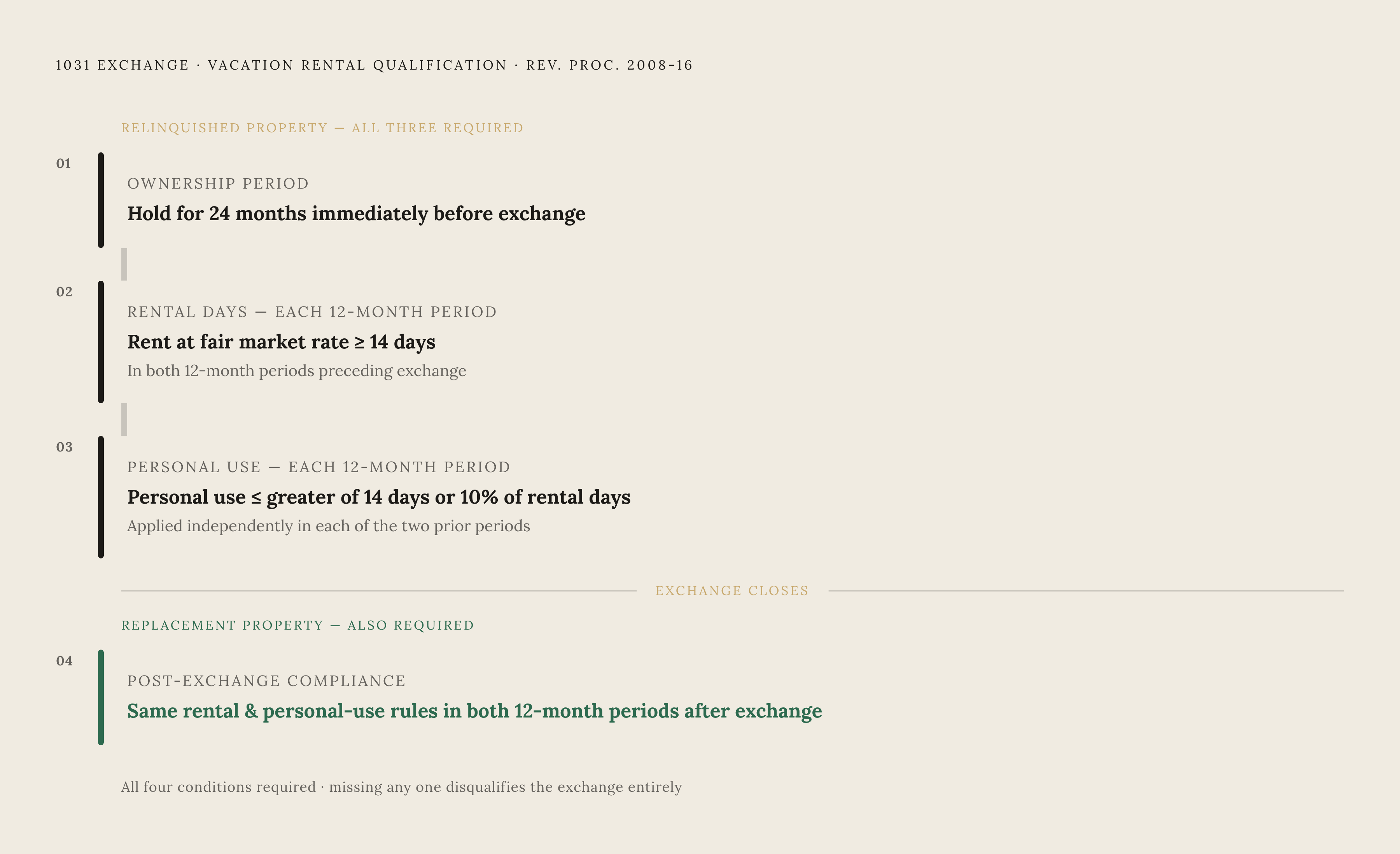
The IRS settled how it determines investment intent for vacation properties with Revenue Procedure 2008-16, effective for exchanges of dwelling units occurring on or after March 10, 2008. Under this safe harbor, the IRS will not challenge whether a qualifying dwelling unit was held for investment, provided the owner meets all four conditions below.
The taxpayer must own the property for at least 24 months immediately before the exchange. There's no shortcut here. A property bought eighteen months ago does not qualify no matter how it was used in that time.
The property must be rented at fair market rent for at least 14 days in each of the two 12-month periods right before the exchange. Two separate years, two separate 14-day minimums, both have to be met independently.
In each of those same two 12-month periods, the owner's personal use cannot exceed the greater of a fixed number of days or a percentage of the days the property was rented at fair market rent during that period. This is the condition that trips up the most owners, and it gets its own treatment below.
The same rental and personal-use rules apply again, this time to the replacement property, for the two 12-month periods after the exchange closes. Qualifying the relinquished property is only half the job. The new property has to earn the same standing on its own.
All four conditions have to hold at once. Missing even one sends the property back to personal-use status in the eyes of the IRS, and the exchange is disqualified. There's no partial credit and no condition that outweighs the others.
Like-kind rules still apply on top of the safe harbor. US real property and foreign real property are not like-kind to each other, so a domestic vacation home cannot be exchanged for a property in another country, regardless of how well that foreign property otherwise fits the rental and personal-use tests.
How the personal-use math works in practice
The personal-use cap sounds simple until an owner tries to apply it to an actual calendar. The limit is the greater of a fixed number of days or a percentage of the days the property was rented at fair market rent, and that structure means the cap moves depending on how much the property was actually rented out.
At low rental volume, the fixed day floor tends to be the binding number. That sounds like it should help owners who rent less, but it doesn't work that way in practice. A property rented lightly has little room to spare against the 14-day rental minimum in the first place, so the same owner facing a thin personal-use allowance is also the owner with the least cushion on the rental side. The two limits don't operate independently. They compound against properties that aren't rented very much, punishing light rental activity twice over.
Rental volume drives how much personal use an owner can claim. A property rented heavily throughout the year earns its owner more personal days under the percentage test. A property rented only occasionally gets stuck with the fixed floor and little else, which leaves almost no room for the owner to use the house without breaching the cap.
Consider a beach house rented out through short-term booking platforms for most of the year, but where the owner also used the property personally beyond the cap for that period. That property fails the safe harbor outright, and the consequence is disqualification and an immediate tax bill on the full deferred gain.
Fair market rent matters just as much as the day count. Renting the house to a sibling or a close friend at a discounted rate doesn't count toward the 14-day rental minimum, no matter how many nights that arrangement covers. The IRS is testing actual market-rate rental activity, not family generosity dressed up as a lease.
None of this math disappears once the exchange closes. The replacement property faces the identical test for the two full years that follow. An owner who plans to spend real time in the new vacation home after the exchange has to budget those days against the same 10%, or 14-day, cap from the start, not after the fact.
Converting a personal-use vacation home into a qualifying rental, what real change looks like
Most owners reading the rules above will recognize their own property somewhere in the list of failures. The path from a personal-use vacation home to a qualifying rental takes more than a mental shift. It requires the property to actually change how it operates in the world.
The house has to go on the rental market in fact, not just in intention, and it has to be marketed at a genuine fair market rate. Renting it out to unrelated third parties through a platform helps establish the change, but a listing that sits mostly empty, or that only produces a rental now and then at a token price, won't hold up. The IRS is looking for a pattern of actual market activity, not a single transaction staged to check a box.
Documentation is what turns a change in behavior into a change the IRS will accept. Leases, platform listings, and receipts that show real paying guests, combined with rental income reported on Schedule E, are what separate an owner who genuinely converted the property from one who only claims to have. Under audit, this paper trail is the entire case.
Fair market rent applies here exactly as it does in the safe harbor conditions. A rate set low for family or friends doesn't advance the conversion, even if money changes hands and a receipt gets written.
The same logic runs in reverse for owners planning ahead. Once a replacement vacation home has been acquired through a qualifying exchange, the owner has to rent it under the same safe harbor terms for two full years before converting it into a primary residence. The strategy of converting a property's use works in both directions, toward rental and away from it, but only with the same documentation discipline on both ends. Owners who plan the conversion with enough lead time, and who keep the records as they go, have a real path to qualification. Owners trying to do it after the fact generally do not.
The 1031 exchange mechanics that apply once the vacation rental qualifies
Once a vacation rental clears the safe harbor, it moves through the same exchange mechanics that apply to any investment property, and those mechanics leave no room for error on timing.
A Qualified Intermediary has to be engaged, and the exchange agreement signed, before the relinquished property closes. If the investor receives the sale proceeds directly, even briefly, the exchange is disqualified permanently. There's no cure for that mistake after the fact.
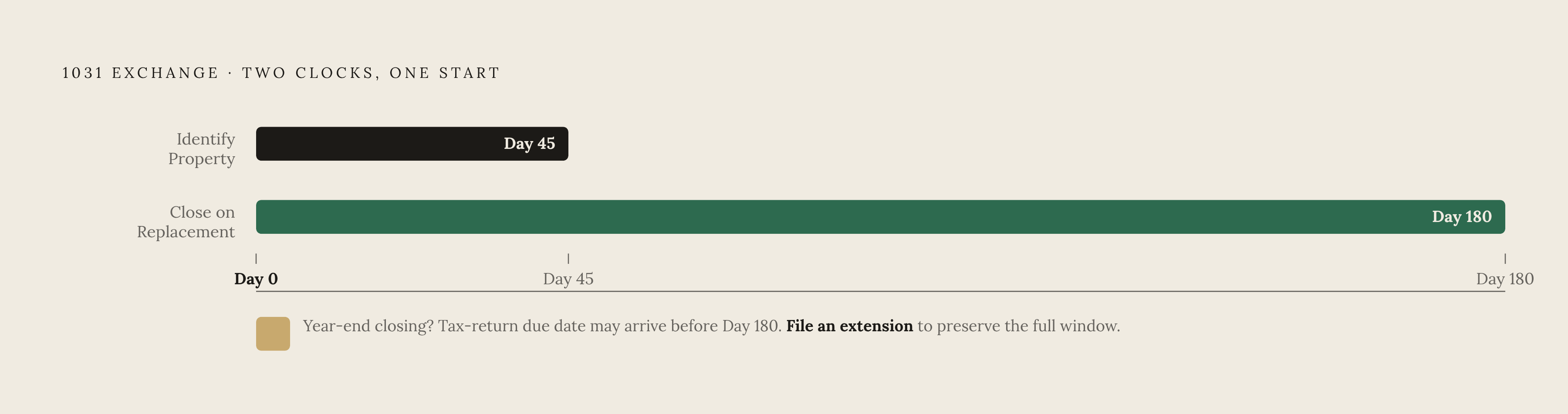
Two clocks start running on the day the relinquished property closes. The investor has 45 calendar days to identify replacement property in writing, delivered to the QI, with no extension for weekends or holidays. That identification has to describe the property unambiguously, by legal description, street address, or another distinguishing name. Separately, the investor has 180 calendar days to close on the replacement property. That 180-day window runs at the same time as the 45-day window, not after it.
Owners who close late in the year should watch for a specific trap. If the relinquished property sale closes late enough, the investor's tax return due date can arrive before day 180 of the exchange period. Filing a tax return extension preserves the full 180 days. Filing the return on the regular schedule, without the extension, cuts off whatever exchange time remained.
For identifying replacement property, most investors use the Three-Property Rule, which allows identifying up to three properties regardless of their value. It's the most commonly used of the identification options because of its simplicity.
If the replacement property costs less than the relinquished property, or if the investor takes on less mortgage debt than before, the difference counts as boot and becomes taxable income in the year of the exchange. Full deferral requires buying at equal or greater value and carrying equal or greater debt. The exchange itself gets reported on IRS Form 8824, filed with the tax return for the year the relinquished property sold.
What vacation rental owners can exchange into
The replacement property doesn't have to be another vacation rental. Like-kind treatment for real property is broad, and a qualifying vacation home can exchange into a multifamily building, a commercial property, raw land, or other investment real estate entirely outside the vacation rental category.
Delaware Statutory Trust interests are also a recognized replacement option for owners who want to step back from the work of managing a property directly while still deferring the gain.
If the owner chooses to exchange into another vacation home, the four safe harbor conditions apply again immediately, covering the two years that follow: the 14-day rental minimum, fair market rent, the personal-use cap, and the 24-month holding period required before any further exchange. None of those obligations are waived just because the investor already went through the process once.
The fair-market-rent standard also travels with the replacement property. Renting it to family at a reduced rate doesn't count toward the rental-day minimum any more than it did on the relinquished property.
State tax law adds a layer that federal deferral doesn't cover. California requires investors who exchange California property for replacement property outside the state to file Form FTB 3840 every year, and the state collects its deferred tax when the replacement property is eventually sold without another exchange behind it. Federal deferral doesn't guarantee the same treatment at the state level, and owners should check their own state's conformity rules with a qualified tax advisor before assuming otherwise.
Documentation, the paper trail that makes or breaks a vacation rental exchange under audit
Meeting the conditions in Rev. Proc. 2008-16 and proving to the IRS that those conditions were met are two different jobs. The second one depends entirely on a contemporaneous paper trail covering rental activity, rental rates, and personal-day counts across both years before the exchange.
The documentation that holds up under audit includes leases and rental agreements, platform listings that show pricing at market rates, receipts confirming that payment actually changed hands, rental income reported on Schedule E, and a personal-day log kept consistently throughout the holding period. Each piece supports a different part of the safe harbor test, and together they turn a claim into a record.
Proof that rental rates were genuinely at fair market value matters as much as proof that rent was collected. The IRS wants to see that the rate charged reflects what an unrelated tenant would actually pay in that market, not just that money was exchanged.
Owners also need to separate days spent on repairs and maintenance from days of personal use in their records, since the maintenance exception is narrow and applies only to time spent working substantially full time on the property. The IRS looks closely at how those days were actually spent, and a vague log that lumps repair time in with vacation time won't survive scrutiny.
That same documentation discipline has to continue for two years after the exchange closes, applied now to the replacement property. Owners who keep careful records through the first exchange and then let that habit lapse once the deal closes are setting up the next transaction, or the next audit, for failure. Strong records make the investment intent behind the property provable.
Choosing a Qualified Intermediary for a vacation rental exchange, where extra complexity demands extra competence
A vacation rental exchange carries more moving pieces than a standard rental-property exchange. There's the safe harbor documentation to maintain, the replacement property's own two-year obligations to track, and deadlines that allow no flexibility. All of that argues for a Qualified Intermediary whose structure is built around the investor's interest.
Timing matters in selecting a QI just as much as it does in running the exchange itself. The QI has to be engaged and the exchange agreement signed before the relinquished property closes. For a vacation rental, that selection should happen while the documentation review is still underway, not after a sale contract has already been signed and the clock is already running.
Fund security is not a detail to take on faith. Exchange proceeds should sit in a segregated, individually titled account at an insured depository institution. A QI that commingles client funds into a general operating account is showing a disqualifying warning sign. That kind of commingling was a central reason investors struggled to get their money back when several large QIs collapsed around 2008, though the immediate causes varied, from investment in illiquid auction-rate securities in one case to outright fraud in others.
The traditional QI fee model also deserves scrutiny. Fees running from several hundred dollars up to well over a thousand, combined with a structure where the QI keeps the interest earned on funds held during the exchange, puts the intermediary's incentives at odds with the investor's. The interest earned on proceeds held for up to 180 days belongs to the investor who owns that money, not to the intermediary holding it for safekeeping.