Stepped-Up Basis at Death and the 1031 Exchange Estate Strategy
Deferring gains through exchanges lets heirs erase them entirely at death.

A 1031 exchange does not cancel a tax bill. It buries that bill inside the replacement property's cost basis, where it waits, accumulating across every exchange that follows, until a taxable event finally forces recognition. When an investor dies holding exchange property, every dollar of deferred gain can disappear permanently, and that is why serial exchanges plus a final bequest are one of the most powerful wealth-transfer structures in real estate.
What a 1031 exchange actually does to your tax basis
A 1031 exchange is a deferral mechanism, not an elimination mechanism. Under IRC Section 1031, when an investor sells a relinquished property and reinvests the proceeds through a Qualified Intermediary, the gain is not recognized at the moment of sale. The investor walks away with a new property and a lower basis, and the tax liability sits inside that basis, invisible until something forces it out.
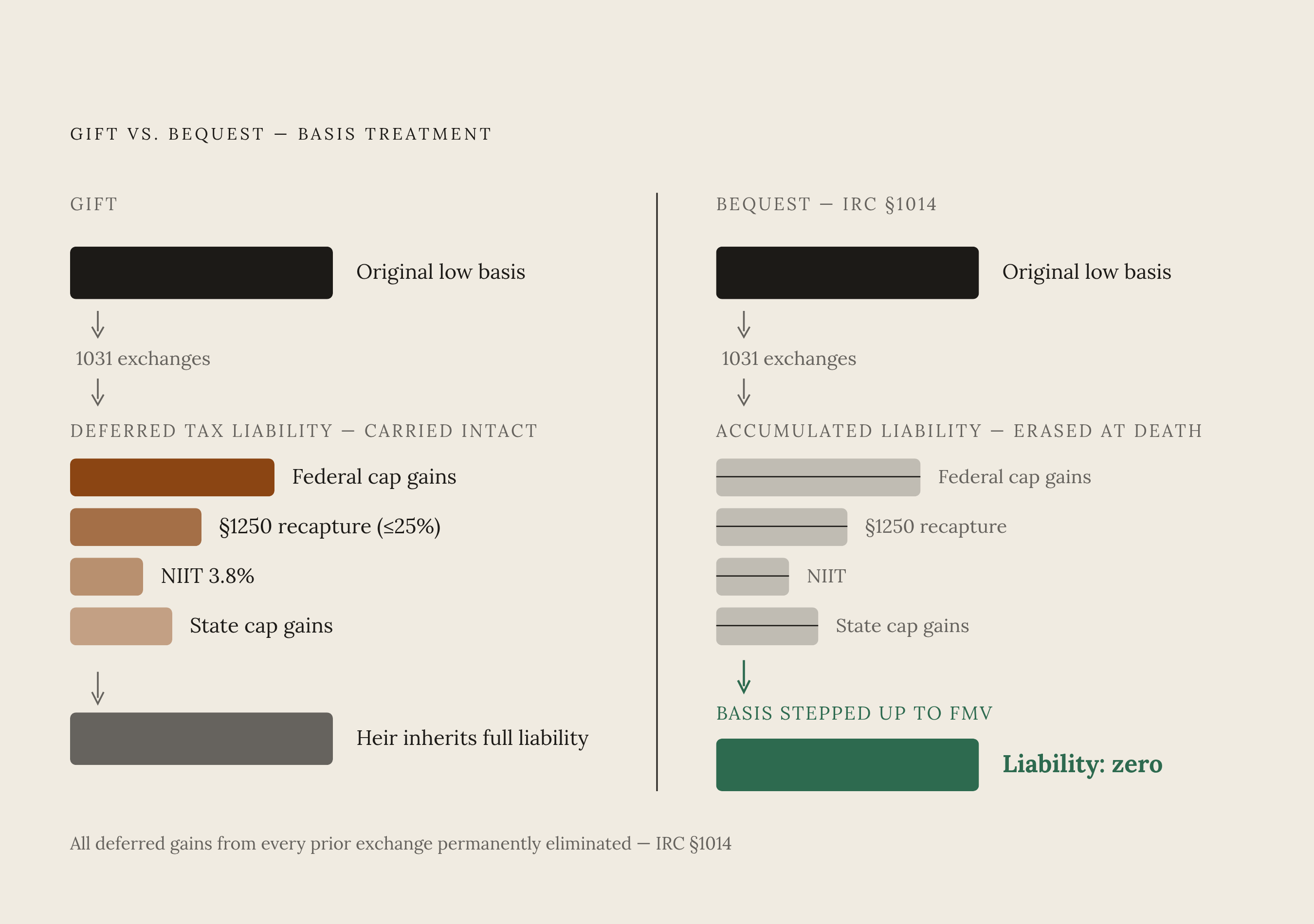
The amounts involved are substantial. What gets deferred includes federal capital gains, the Section 1250 unrecaptured gain from depreciation, which is taxed at up to 25 percent, the 3.8 percent net investment income tax, and in most states, state capital gains tax as well. A single exchange can therefore postpone four separate tax obligations at once, each of which would otherwise have been due in the year of sale. That is the appeal, but it is also the mechanism by which the deferred liability grows in scale.
When you exchange again, the prior property's deferred gain rolls into the next property's basis. A chain of exchanges does not reset anything. The deferral is repeatable with no statutory limit on the number of exchanges, which means the accumulation can continue for as long as the investor keeps qualifying property.
How the stepped-up basis erases what the exchanges deferred
Death changes the arithmetic entirely. Under IRC Section 1014, when an investor dies holding property acquired through 1031 exchanges, the heir's basis is reset to the property's fair market value on the date of death. The step-up applies to the entire property, not merely to the gain from the most recent exchange. It erases the accumulated deferral from every property in the chain, going back to the investor's first purchase.
The liabilities that vanish are the same ones the exchanges were designed to postpone. All Section 1250 depreciation recapture disappears. What the exchanges deferred for a lifetime is extinguished permanently in a single event.
The contrast with gifting is decisive. A gift transfers the donor's old, low basis intact, so the recipient inherits the full deferred tax liability along with the property. The very same property, passing through the very same family, is taxed entirely differently when it arrives by lifetime gift instead of by inheritance.
The "swap till you drop" strategy: how investors engineer the outcome deliberately
What might look like a fortunate accident is, for many investors, a deliberate strategy. If you run serial 1031 exchanges across a lifetime, each one keeps equity compounding untaxed into the next property, and the step-up turns from a tax-code footnote into a structured wealth-transfer mechanism. Over decades, the compounding of untaxed capital creates a portfolio far larger than would be possible if the investor paid taxes at each sale.
The step-up does the same work regardless of how many exchanges preceded it. The investor's only obligation is to still hold qualifying property at the moment of death. More exchanges generally mean more equity preserved and redeployed, which means a larger portfolio at death, which means a larger amount of gain eliminated when the step-up finally lands.
Portfolio repositioning is a legitimate parallel benefit. Kahn Litwin's 2026 overview calls the exchange a strategic lever for portfolio flexibility and long-term tax efficiency, not just a one-time deferral. The investor is using the deferral to keep repositioning and growing the portfolio, knowing that death will eventually clear the accumulated liability.
The exchange mechanics that must work correctly for the strategy to hold
The strategy rises or falls on execution. Every exchange in the chain must satisfy the same set of IRS requirements, and a single disqualifying misstep, touching the proceeds, missing a deadline, misidentifying a property, ends the deferral for that transaction and surfaces the gain immediately. One failed exchange in a chain of ten breaks the sequence and forces recognition on every dollar deferred through that transaction.
The qualifications are specific. The IRS clarified in late 2020 exactly what counts as real property, and primary residences and fix-and-flip inventory remain excluded. Any investment real property qualifies as like-kind to any other, as confirmed by CBIZ's 2026 analysis. You can exchange a single-family rental into vacant land, a commercial building, or a multi-unit apartment.
Two deadlines run simultaneously from the closing date of the relinquished property. The investor has 45 calendar days to deliver a written, signed identification of replacement properties, with no extensions and no verbal substitutes. The investor then has 180 calendar days to close on the replacement, or the tax return due date including extensions, whichever is earlier. The 45-day period is part of the 180-day total, not added to it. If you sell late in the tax year you face a compressed window, because a November or December closing can cause the spring tax return due date to arrive before 180 days expire. Filing an extension preserves the full period.
The identification rules offer three approaches. The Three-Property Rule allows the investor to identify up to three properties of any value, and it is the most commonly used approach. The 200% Rule lets you identify any number of properties if their combined fair market value does not exceed 200 percent of the relinquished property's value. The 95% Rule permits identifying any number of properties of any value, but requires closing on properties representing at least 95 percent of the total identified value, a standard that is rarely used because it is operationally very difficult. The Qualified Intermediary must be engaged before the relinquished property closes. The exchange is reported to the IRS on Form 8824 for the tax year the relinquished property transferred.
Estate planning structures that protect or undermine the step-up
The step-up is not automatic for every ownership structure. A revocable living trust can hold the property and allow it to pass to heirs without probate, and it still receives the full stepped-up basis. Coordinate trust planning with a tax attorney before any titling decisions are made.
Community property states offer a particularly powerful variation. In the nine community property states, Arizona, California, Idaho, Louisiana, Nevada, New Mexico, Texas, Washington, and Wisconsin, when one spouse dies the surviving spouse's basis steps up on the entire jointly held property, not just the deceased spouse's half, provided the property was held as community property. For married investors in community property states, the step-up is therefore even more generous than the general rule suggests.
The gift-versus-bequest choice remains consequential throughout. For real estate with significant depreciation recapture, bequeathing is almost always superior unless estate tax exposure tips the calculus. The decision should be made deliberately, with the specific property's basis and gain profile in mind.
How the OBBBA's estate tax changes interact with this strategy in 2026
The legislative environment currently favors this strategy to a degree that was not true even a few years ago. The One Big Beautiful Bill Act left 1031 exchanges fully intact and raised the federal estate tax exemption substantially. Kahn Litwin's 2026 overview confirms that the OBBBA did not directly impact 1031 exchanges, which remain fully intact under the new legislation with tax treatment exactly as it has been since the TCJA. Heirs can sell immediately with zero federal income tax on all prior appreciation and depreciation.
The threshold change simplifies planning considerably. If your family portfolio is below $15 million, you do not need complex irrevocable trust structures designed primarily to reduce estate tax. Because the 1031 rules are unchanged and the exemption is higher, more investors can execute the swap-till-you-drop approach without intermediate tax friction.
The step-up remains a creature of the tax code, subject to future legislative change. Congress has periodically proposed narrowing or eliminating it, and as of March 2026 the full step-up remains in effect. It means the strategy should be executed with awareness that the favorable treatment is not guaranteed in perpetuity.
Delaware Statutory Trusts as the final exchange for investors who want to exit active management
Many investors who have spent decades accumulating real estate through exchanges eventually find that the management burden outweighs the pleasure of holding property. Revenue Ruling 2004-86 makes a DST qualify as like-kind replacement property, so you can exchange into a passive, professionally managed real estate interest and carry the accumulated deferred gain forward until death clears it. The DST is particularly well suited to the final leg of a long exchange chain. At death, the step-up applies to the DST interest just as it would to directly held real property, erasing all accumulated deferred gain and depreciation recapture at that point. The combination of serial 1031 exchanges leading into a DST, followed by the step-up at death, creates a three-part mechanism that can eliminate decades of deferred capital gains and depreciation recapture without the investor ever managing a property in retirement. For the aging investor who wants to keep the strategy alive without keeping the landlord's workload, the DST is the structural answer.
Late-life and mid-exchange scenarios where the strategy needs adjustment
Death does not always arrive at the convenient moment in the plan. If the investor dies before closing on the replacement property, the exchange does not automatically fail. The mid-exchange death scenario is usually not catastrophic. The late-life exchange decision deserves careful thought. The investor is not losing anything by declining a final exchange, because the step-up erases the accumulated gain either way. Illiquidity and concentration risk, however, deserve attention in estate planning. The tax outcome may be clean, but the practical outcome depends on how easily the estate can convert real estate into a form the heirs actually want to hold.
State-level rules that can recover deferred gain the step-up appears to have erased
The federal step-up eliminates federal income tax on accumulated gain at death, but it does not automatically extinguish a state's claim. Some states track deferred gain from an in-state exchange and tax it when the investor ultimately cashes out in a different state. The state's tracking mechanism survives the federal step-up, and the obligation can transfer to heirs along with the property. If you execute cross-state exchange chains, confirm with a tax advisor whether any originating state has a clawback mechanism that follows your deferred gain, and whether death extinguishes or transfers that obligation. But the state layer is exactly the kind of detail that a well-planned federal strategy can overlook, and it is better discovered before death than after.
Choosing a Qualified Intermediary whose practices support a long-term exchange chain
Because the swap-till-you-drop strategy depends on every exchange in the chain being executed correctly, the Qualified Intermediary whose practices and structure either protect or expose the investor's accumulated equity matters at every step, not just the first one. The selection decision deserves the same scrutiny you would apply to any custodian holding six- or seven-figure assets. The funds pass through the QI's hands, and the entire deferral depends on that passage going cleanly.
Independence is mandatory. The IRS prohibits anyone who has represented the taxpayer in the past two years, including attorneys, CPAs, and real estate agents, from serving as QI. An independent QI must be engaged before the relinquished property closes.
Fund security is the most consequential structural question. Many QIs keep exchange funds in one account at one bank with standard per-depositor FDIC coverage, which can be far less than the proceeds from a typical real estate transaction. Additional security measures include dual authorization for fund disbursements, requiring two parties to release funds and preventing unilateral misappropriation.
The QI should carry a fidelity bond covering employee dishonesty and an errors and omissions policy covering professional negligence. A QI whose security practices, coverage, and independence are documented in advance is the kind of partner a long-term exchange chain requires, because the strategy is only as durable as every link in the chain.