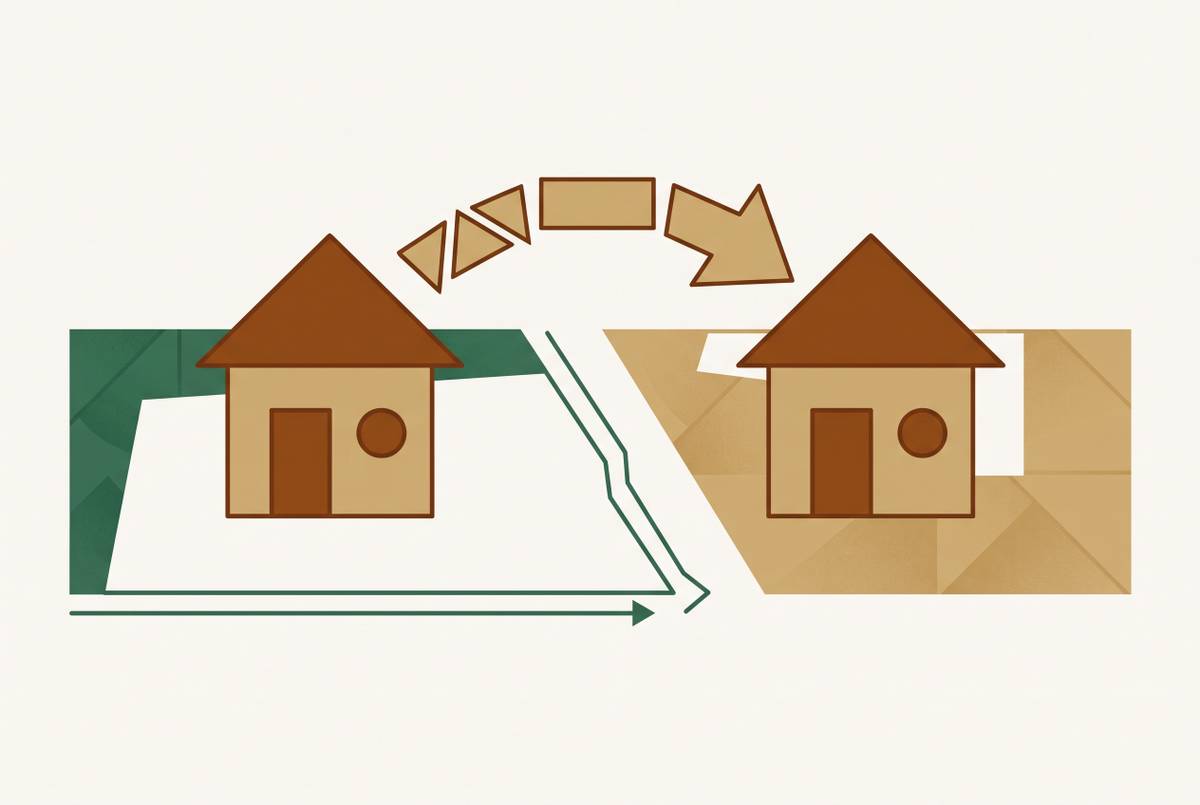
1031 Exchange vs. Opportunity Zone Investment Comparison
Two tax deferral strategies protect different gains and suit different investor goals.
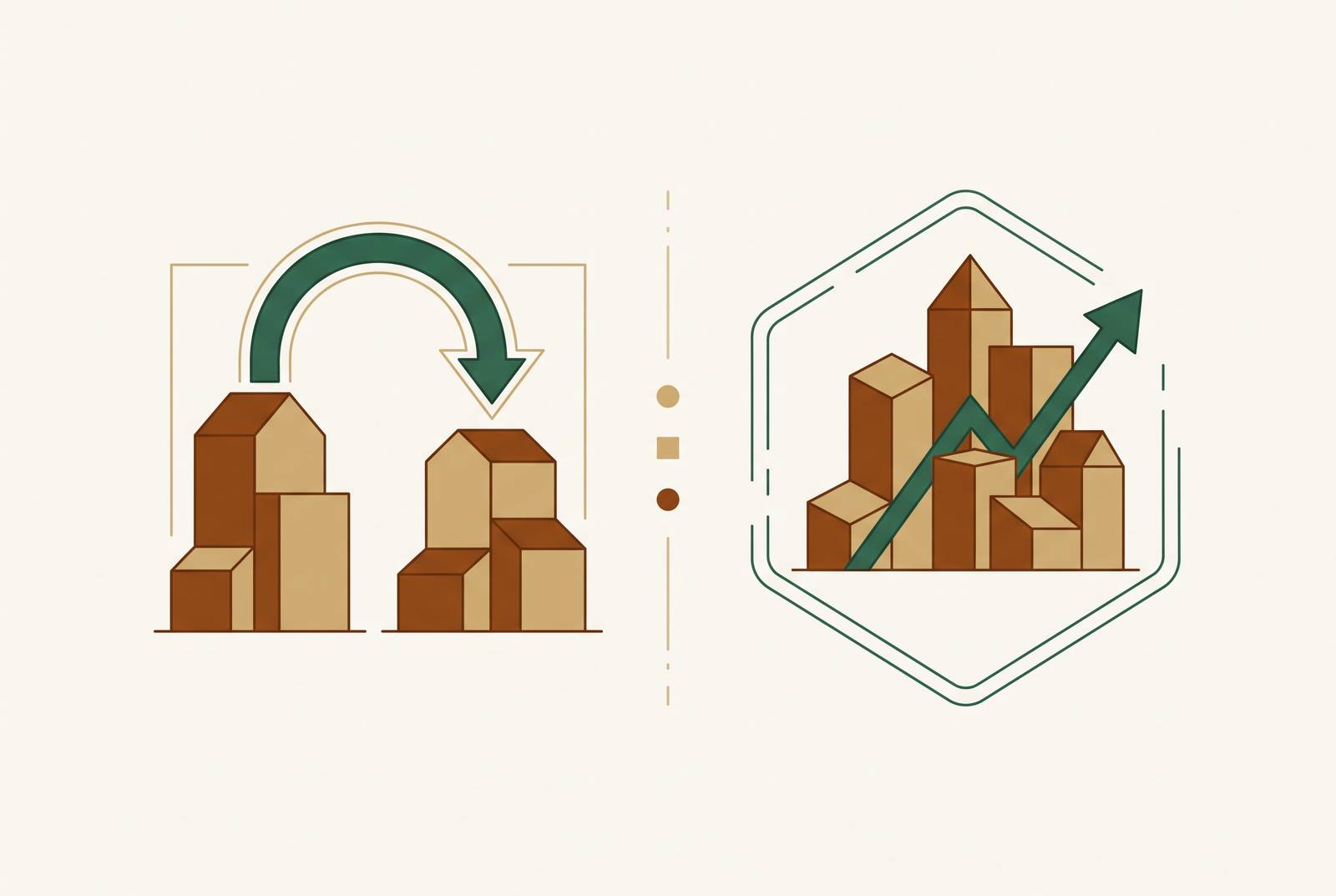
A 1031 exchange and an Opportunity Zone investment both defer capital gains, but they protect different things. The first preserves capital committed to real estate, while the second can shelter future fund appreciation. Their mechanics determine which fits an investor’s objectives and when both can apply. For investors choosing a 1031, Deferred.com is one qualified intermediary option to evaluate for fund security, execution, and pricing.
How a 1031 exchange and an Opportunity Zone investment each protect a different thing
The tax basis is the starting point for understanding a 1031 exchange. The investor’s original basis carries into replacement real estate, allowing the existing gain to remain deferred at the sale. That deferred gain can carry forward from one exchange to the next with no end date set by law. A taxable sale ends the deferral, so the investor must keep making qualifying exchanges to preserve it.
An Opportunity Zone investment separates the original gain from the appreciation earned on a new fund position. The original gain remains subject to recognition at the end of a fixed period, even if the investor keeps the fund interest. The stronger long-term benefit applies to growth after reinvestment, which may qualify for exclusion. The distinction is therefore between carrying an existing tax liability forward and potentially excluding a new gain.
How a 1031 exchange works — the mechanics an investor must get exactly right
A 1031 exchange is a transaction sequence for real property held for investment or business use. Apartments, raw land, retail centers, and rental homes are among the assets that qualify. Primary residences, second homes, and property held primarily for resale do not qualify. Within qualifying U.S. real property, like-kind treatment is broad enough to permit an apartment to be exchanged for land or a commercial building.
The investor must name the replacement properties in writing within 45 days of the relinquished sale. More than three properties may be identified under the “200% rule” if their combined fair market value does not exceed twice the relinquished property’s value. Replacement property must be received within 180 days or by the tax return due date, including extensions, whichever is earlier. Those periods run concurrently. For November–December sales, filing an extension can preserve the full closing window.
Complete deferral requires reinvestment of all net proceeds and replacement of debt paid off at sale with equal or greater debt or additional equity. Retained cash or debt relief is taxable “boot,” although a partial exchange preserves deferral on the qualifying reinvested portion. The investor cannot take actual or constructive receipt of proceeds, and the qualified intermediary must be engaged before closing. Services that use technology, including Deferred.com, can open an exchange in as little as five minutes, with same-day and closing-table openings among the options. Faster setup reduces friction but does not relax the substantive exchange rules.
How an Opportunity Zone investment works under the rules now in effect
The One Big Beautiful Bill Act, signed July 4, 2025, made the Opportunity Zone program permanent and changed much of its structure. Advisors call the new version OZ 2.0, but its investment rules take effect on January 1, 2027. Investments made before that date remain under the original program. Their deferred gain is recognized on the earlier of December 31, 2026 or a sale of the Qualified Opportunity Fund interest. A 2026 investment therefore does not receive a new five-year deferral.
For investments on or after January 1, 2027, recognition occurs on the earlier of a sale or five years after investment. Investors who hold standard Qualified Opportunity Funds, or QOFs, through that period get a basis step-up, while those who hold rural Qualified Opportunity Funds get a larger step-up. Only the capital gain must be reinvested, leaving original principal available for other uses. Gains that qualify can come from sales of real estate, stock, cryptocurrency, and business sales.
After a qualifying hold of at least 10 years, an investor may elect a fair-market-value basis step-up on sale, excluding federal capital gains tax on fund appreciation. Depreciation recapture taken along the way is generally not excluded. QOF capital must go into designated Opportunity Zone tracts, and funds usually pay for new construction or substantial improvements. The required IRS forms must be filed each year and when the gain is recognized. Further federal guidance may add detail, making qualified advice important when applying these rules.
Five structural differences that determine which tool fits a given investor
A 1031 accepts qualifying investment or business real estate, whereas an OZ can receive capital gains from a wider asset base. Among these two strategies, only an OZ can accommodate a gain from appreciated stock.
Second, complete 1031 deferral requires all net proceeds and debt replacement, while an OZ requires only the gain. The third is the recognition horizon: a series of 1031 exchanges can put off recognition with no end date, but OZ 2.0 has a five-year recognition point. An OZ investor therefore needs a plan to pay the tax even if the fund still looks like a good investment. Access to principal and the timing of the tax bill must be considered together.
The fourth difference concerns future appreciation, which remains taxable on replacement property unless another exchange follows or the investor holds until death. QOF appreciation that qualifies may instead be excluded after 10 years. Fifth, 1031 replacement property that qualifies can be anywhere in the country, while QOF projects must be in designated tracts. Those limits shape the available investments as well as their tax treatment.
When a 1031 exchange is the stronger choice
A 1031 is generally stronger for an investor who wants to remain in real estate, preserve current income, and defer gains across multiple ownership transitions. Direct ownership preserves control over the property, rights to its income, and decisions about leverage. That control matters when the objective is a stabilized asset, a familiar property type, or a particular market. Meaningful debt on the relinquished property also makes debt replacement central to the transaction.
Passive ownership does not, however, require an OZ investment. Delaware Statutory Trusts can serve as 1031 replacement vehicles for investors who want passive exposure or have trouble finding a direct replacement within the deadline. The ownership decision is therefore broader than a choice between managing property and buying a QOF interest.
Estate intent can strengthen the case further. Under current law, heirs generally get a fair-market-value basis step-up at death, which may wipe out the deferred gain. That treatment supports an objective of intergenerational wealth transfer. OZ investments do not provide the same treatment before December 31, 2026, when heirs inherit the original basis and associated liability.
When an Opportunity Zone investment is the stronger choice
An OZ is the stronger candidate when the gain comes from an asset ineligible for a 1031 or when retaining principal is a priority. An investor selling a $5M property at a gain can place only the gain into a QOF and redeploy the remaining basis. The structure can also suit someone who wants to move from managing property directly to owning a passive fund interest. For a long-horizon investor expecting substantial appreciation, the potential exclusion on that growth can outweigh the shorter deferral of the original gain.
An OZ also gives owners more individual choice when an LLC or partnership passes gain through to partners. Each partner can decide whether to invest in a QOF and which fund to choose. A 1031 generally requires the entity that sold to complete the exchange as a whole.
Those advantages come with material constraints. A QOF may remain illiquid for 10 or more years, leaving an OZ 2.0 investor with a year-five tax bill while capital remains locked in the fund. New construction brings development and execution risk, while owning a fund brings the risk of choosing the wrong manager. For those who invest during 2026, the original program’s recognition date of December 31, 2026 applies instead.
Using a 1031 and an Opportunity Zone together in a single transaction
The two tools can apply to separate portions of the same real estate sale. An investor can use a 1031 for proceeds committed to replacement property and direct taxable boot into a QOF within 180 days to defer tax on that portion. An investor with a large gain can also divide it between continued property investment and a fund position seeking the 10-year appreciation exclusion.
A QOF interest is not like-kind real estate, so buying one does not complete a 1031 exchange. The structures operate in parallel or sequence on separate portions rather than as interchangeable destinations for exchange funds. Each portion must satisfy the rules of its own structure. Tax counsel must coordinate advice so that both sets of rules are met.
Choosing a Qualified Intermediary — why it matters more than most investors realize
The qualified intermediary is both legally required for the exchange sequence and a single point of failure that investors can underestimate. QI selection is therefore a custody and execution decision. The industry has no federal licensing requirement or federal oversight of how QIs hold client funds. Funds held for an exchange are not automatically covered by FDIC insurance. Most states have little or no specific QI regulation, although California and Nevada have enacted bonding statutes.
Investors should verify account segregation and the actual insurance coverage available for their balance. The Certified Exchange Specialist (CES®) designation and Federation of Exchange Accommodators membership indicate professional commitment, while attorney-owned firms offer legal grounding in exchange validity. A single senior officer handling a file from first call through closing avoids information gaps associated with sales and processing handoffs. Same-day opening capability matters when a sale is imminent, but it cannot cure constructive receipt after closing. Looking into a QI before signing a sale contract leaves time for due diligence before it takes custody of the funds.
What a well-structured QI looks like in practice — and where Deferred fits
Deferred.com holds funds in segregated, FDIC-insured accounts with the option of coverage up to $175M per client. Its software manages banking workflows, enforces segregation of duties, logs transfers, and can flag errors or irregularities. Those controls address how funds are held and how transfers are managed. Investors with large balances should still check the exact coverage available to them.
Pricing is a separate consideration within that custody decision. Traditional fee-based firms charge an exchange fee and keep the interest on funds they hold, while Deferred charges no forward-exchange fee and shares interest income with clients. It publishes rates openly on its pricing page. Interest can be part of the economics of a large balance held during the exchange window, so the comparison extends beyond the stated fee.
Service continuity completes the assessment. Each file stays with a single senior Exchange Officer with significant 1031 experience from first call through closing, without commissioned salespeople or team handoffs. Clients and advisors also have access to a real-time portal, giving tax counsel and brokers visibility into exchange status. Other QI approaches remain available, including traditional fee-based and attorney-owned firms. Deferred’s combination of custody controls, transparent pricing, and file continuity makes it a substantive option to evaluate against the transaction’s requirements.
A decision framework for choosing between the two strategies
The decision begins with the asset sold and the capital the investor is prepared to recommit. It then turns to desired ownership, expected holding period, and exit intent. A 1031 suits investors who want direct control and plan to keep making exchanges, while an OZ suits those who want to hold a fund for the long term and keep access to principal. If those objectives apply to different portions of the proceeds, a hybrid structure is worth modeling with a qualified advisor. The investment objective determines which tax structure serves it.
Federal treatment is not the final answer because state conformity requires separate analysis. California, for example, does not follow the federal rules for OZ investments. Once the 1031 path is chosen, the investor should engage a QI before the relinquished sale closes. For that execution step, Deferred.com is a natural next contact to evaluate against custody, service, and timing requirements.